Choosing a blow moulding machine: EBM, IBM or ISBM? Which one suits your application?
Choosing a blow moulding technology is not a matter of taste or brand. Five properties of the product, taken together, almost always decide whether an extrusion, injection or injection stretch blow moulding machine is needed. This article walks through those five questions and shows where the decision goes wrong in practice.
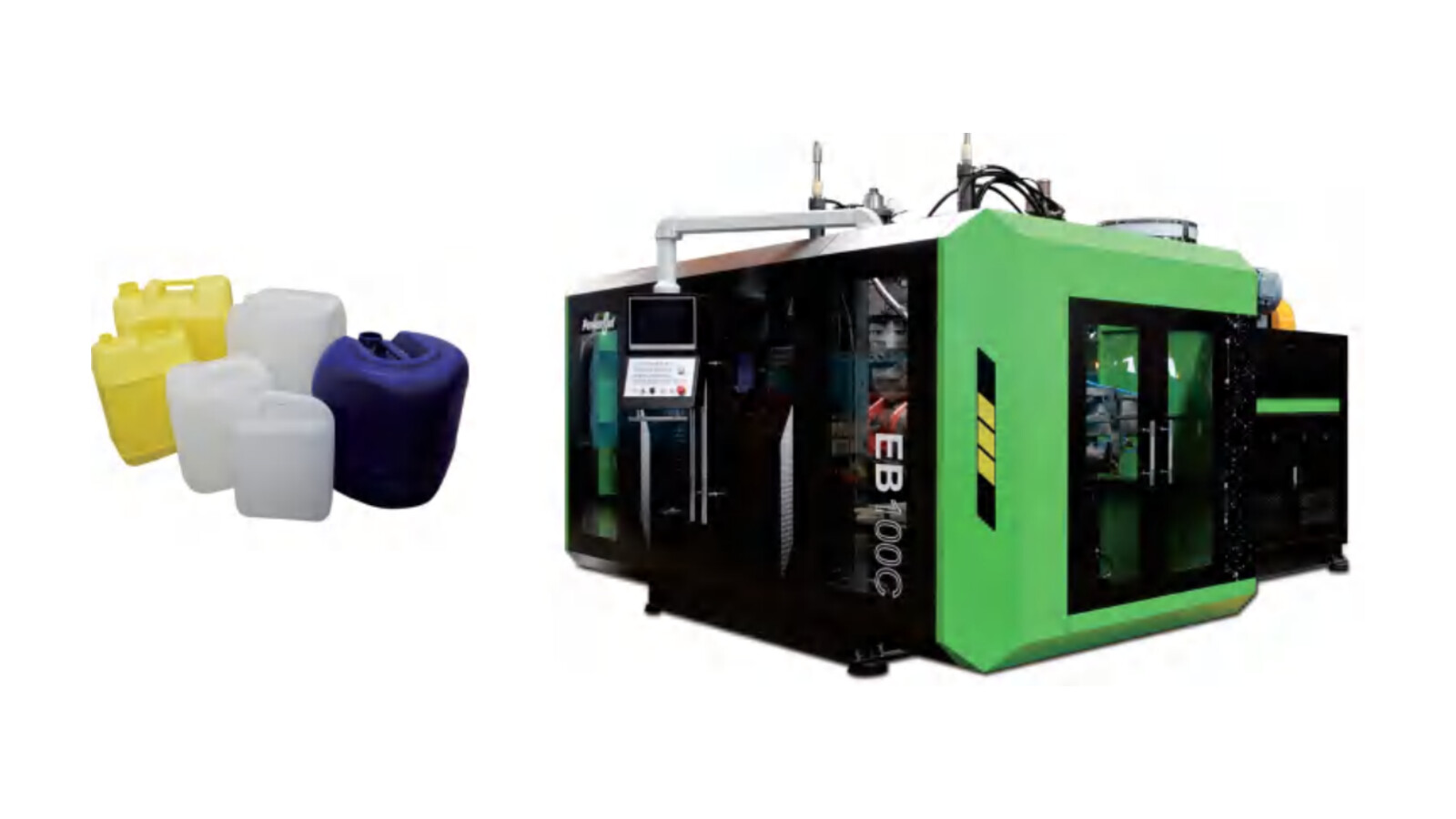
First-time buyers of a blow moulding machine often start from the machine type: “we need a blow moulder”. The correct order is the reverse. Product first, then technology, and only then the machine. Three basic processes are established for blowing hollow parts: extrusion blow moulding (EBM), injection blow moulding (IBM) and injection stretch blow moulding (ISBM). The three processes are not cheaper or dearer versions of one another; they serve different product ranges. A wrong choice does not hurt because the machine fails to run, but because every single bottle ends up dearer, heavier or weaker than it could be.
01. The three processes in one diagram
All three processes rest on the same principle: a still formable, warm plastic preform is blown against the wall of a closed mould with compressed air, cooled and removed. The difference lies in what the preform is and how it is made.
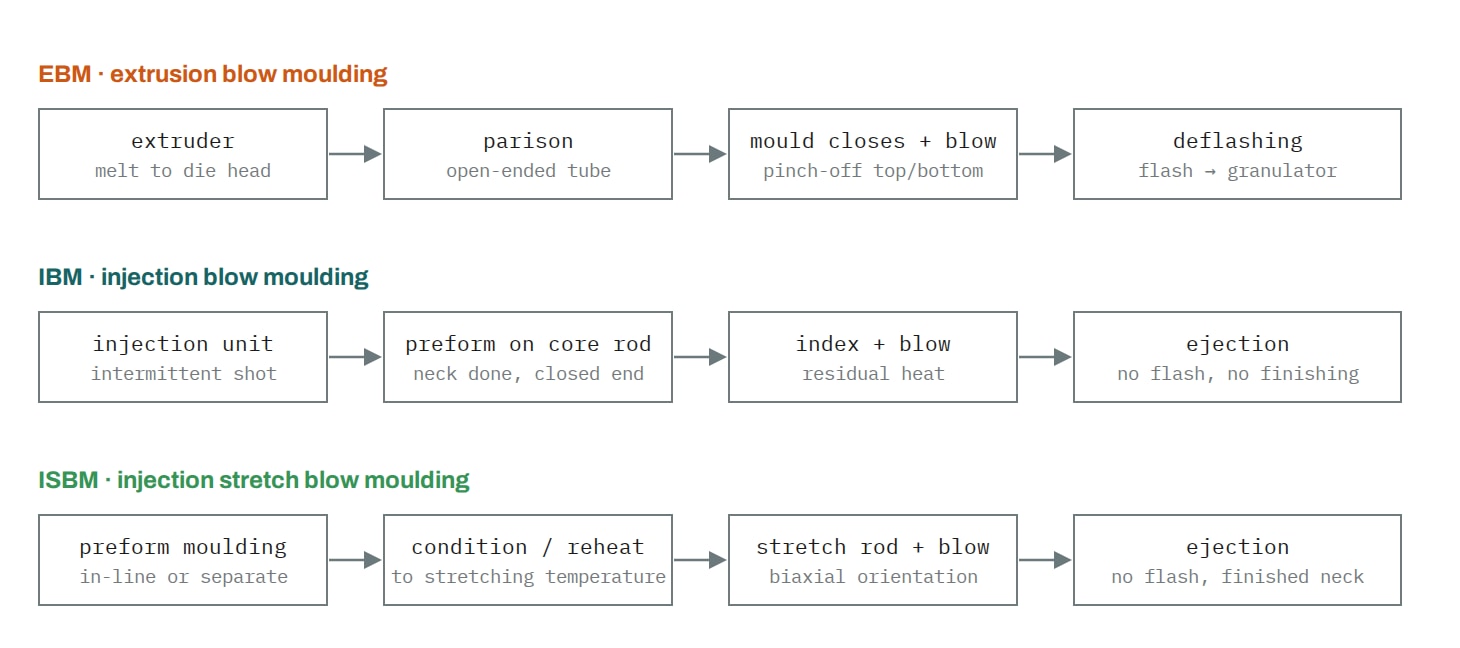
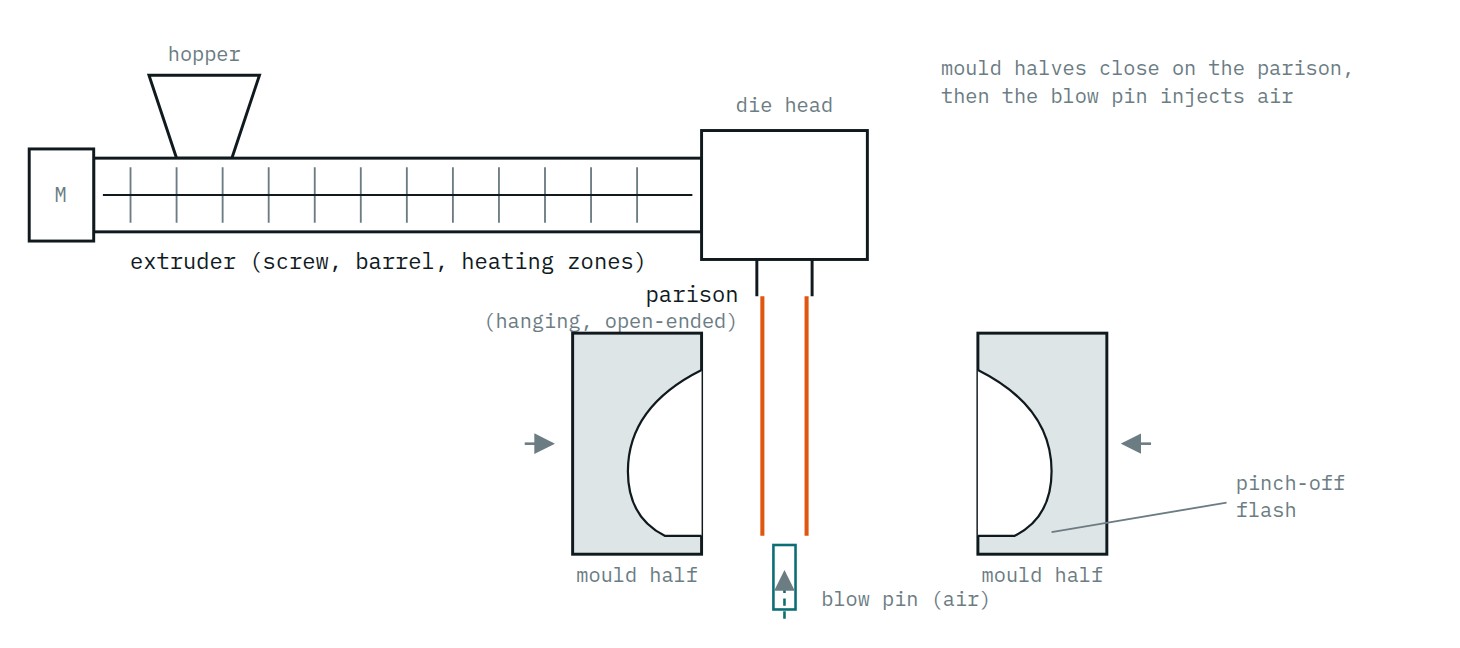
Extrusion blow moulding (EBM)
The extruder melts the material and feeds it to the die head, where a hanging, open-ended tube, the parison, is formed through the annular die gap. Depending on the machine design the parison is extruded continuously or intermittently (accumulator head); the intermittent variant is typical for large jerrycans, drums and technical hollow parts. The two mould halves close on the parison, pinch it off at the base, and the blow pin injects air. Flash remains around the neck and base, which has to be trimmed and reground. The strength of the process is freedom: handles, oval or rectangular cross-sections, multilayer walls and large volumes are all feasible.
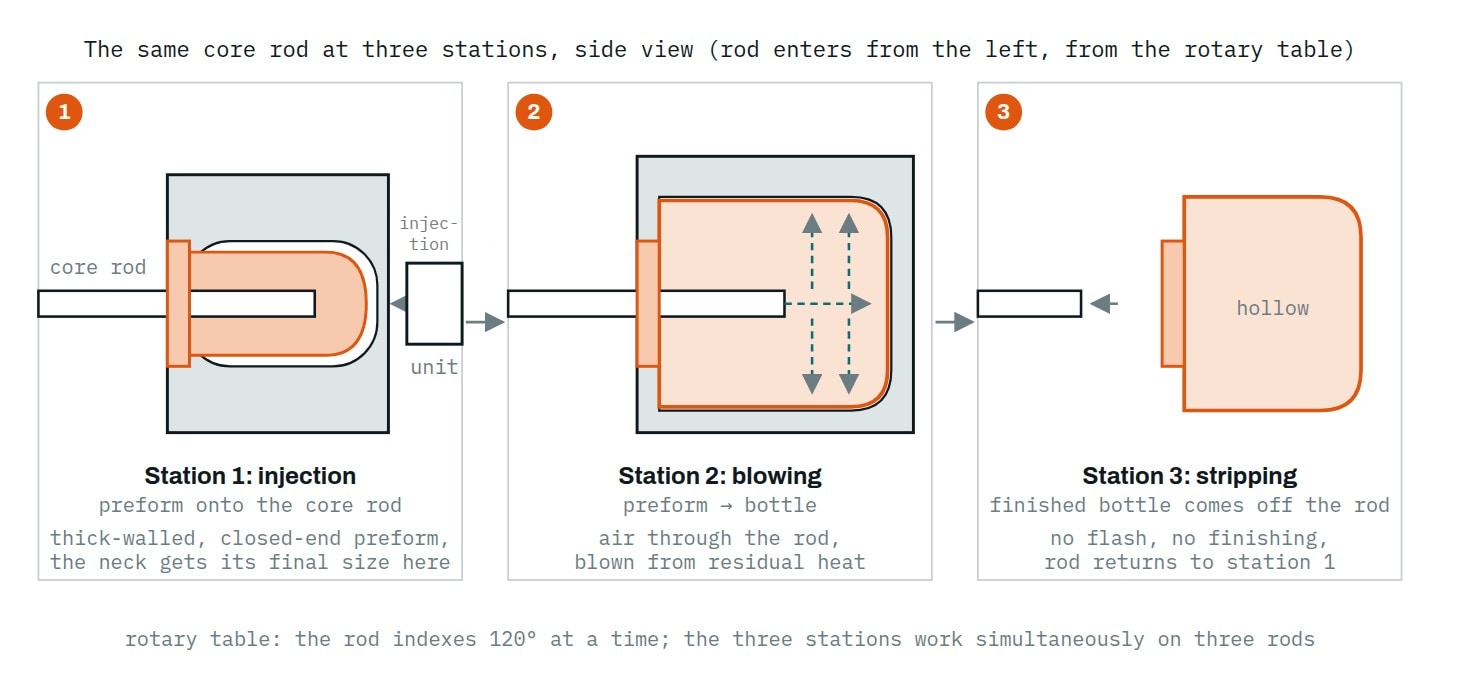
Injection blow moulding (IBM)
The preform is a thick-walled body injection moulded onto a core rod, closed at one end, whose neck is moulded to final dimensions during injection. The rod indexes the still-hot preform into the blow mould, where it is blown from its own residual heat. There is no flash, no finishing, and the neck has injection moulding accuracy. In return, the process suits small and medium volumes without an integral handle, typically pharmaceutical, cosmetic and single-dose packaging; oval or other non-round bodies can also be produced by IBM.
Injection stretch blow moulding (ISBM)
The starting point is the same as for IBM, but before blowing a stretch rod elongates the preform axially, and only then follows the radial blow. Biaxial orientation aligns the molecular chains, which in PET significantly improves strength and gas barrier. This is the process behind carbonated drink and mineral water bottles. It comes in two variants: a one-stage machine injection moulds and blows the preform in-line, while in a two-stage system the preform is a separate (possibly purchased) product that the blowing machine reheats.
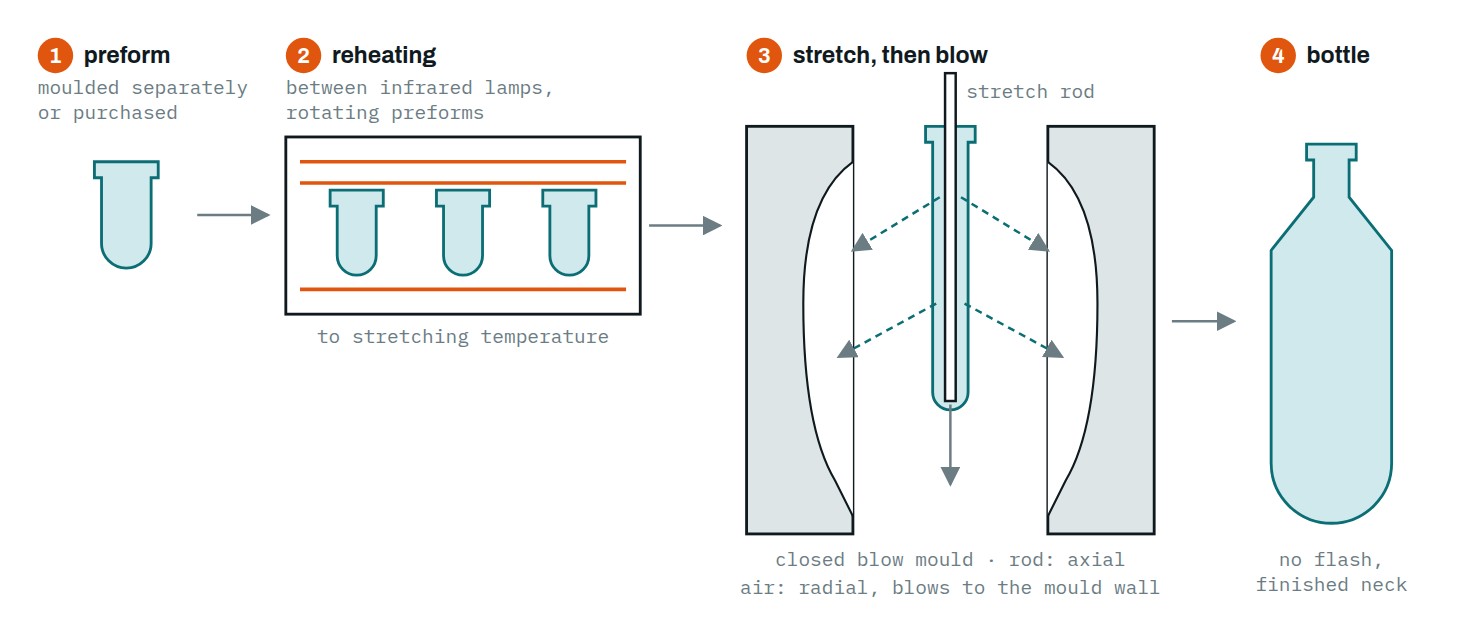
What to take away: EBM is the technology of shape freedom, IBM of neck accuracy, ISBM of PET strength. If the product explicitly requires one of these, the decision is essentially made. The hard cases are those where none of them is compelling.
02. The five questions that decide the technology
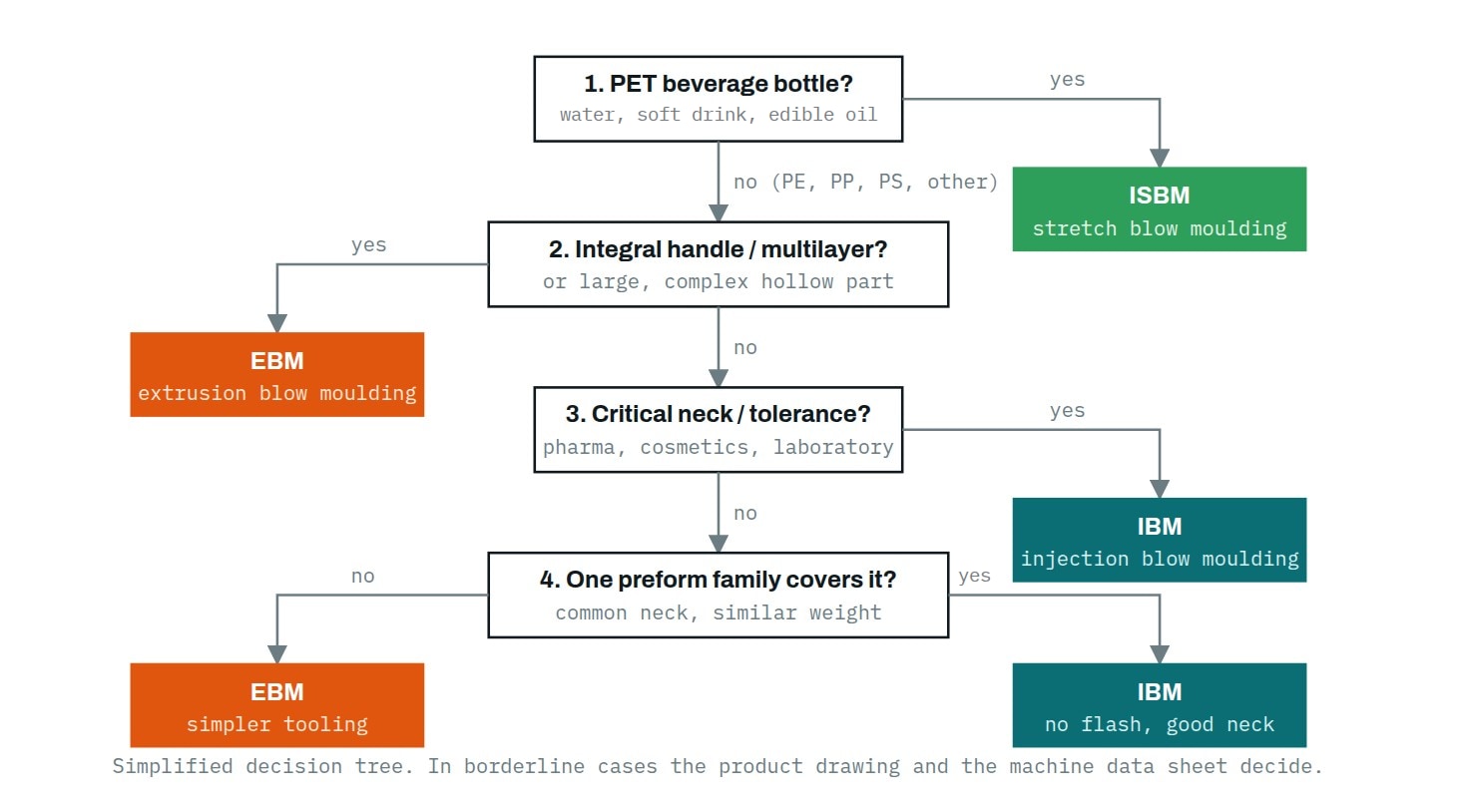
The five questions below start from the application, not from the machine. In our experience the answer is clear by the second or third question in most cases. This is an empirical observation, not industry statistics.
Question 1: What material is the product made of?
This is the strongest filter. For PET beverage bottles ISBM can be regarded as the default technology, because biaxial stretching significantly improves the mechanical and gas barrier properties of PET. Polyolefins (PE-HD, PE-LD, PP) are the materials of extrusion blow moulding, because they give a parison with sufficient melt strength that hangs stably from the die head. The material range of IBM is wide: PP, PE, PS and engineering polymers that are difficult to extrude into a stable parison can also be processed.
Question 2: What is the volume?
Extrusion blow moulding covers the widest scale, from bottles of a few tens of millilitres to industrial jerrycans and drums. IBM is the domain of small volumes: because of the injection moulded preform and the base centre, which is hard to control during blowing, it is no longer economical for larger bodies. ISBM is strongest in the typical beverage bottle range, from a few hundred millilitres to a few litres. These are ranges, not hard limits, and the technical data sheet of the specific machine is decisive. Volume will be the topic of our next article, which covers 5–30 litre HDPE jerrycans.
Question 3: Is an integral handle or a coextruded multilayer wall required?
If the product requires a hollow handle moulded integrally with the bottle body or a coextruded multilayer wall structure, that points strongly towards extrusion blow moulding. An oval or rectangular shape alone does not decide the technology: such geometry can also be produced by IBM and ISBM, although EBM offers greater shape freedom. The integral hollow handle is formed by pinching off the parison; in IBM and ISBM this solution is not available, and a separate handle element is used instead, which depending on the machine may even be inserted automatically. A multilayer wall, for example a chemical or food bottle with an EVOH barrier layer, is most naturally produced in EBM with a coextrusion head. Multilayer structures exist in ISBM too, but they require multi-component injection moulding of the preform, which is a separate mould and machine level question.
Question 4: How critical are the neck and the wall thickness tolerance?
In pharmaceutical, cosmetic or laboratory packaging the neck thread, the sealing surface and the uniformity of the wall thickness are often more important than the shape. These are delivered by an injection moulded neck, hence IBM or ISBM. In extrusion blow moulding the neck is a geometry formed and calibrated by the blow mould and the blow pin, and where applicable a neck insert; on a good machine with a good mould it is also accurate, but the principle differs: it is not an injection moulded neck as in IBM or ISBM.
Question 5: What are the quantities, and how frequent are product changes?
In conventional EBM the flash ratio depends on the product, but it typically has to be reckoned with, and it means material as well as granulator and regrind feeding capacity. IBM and ISBM produce no flash. The preform geometry is closely tied to the finished product, but a product change does not necessarily mean a preform mould change: especially in two-stage ISBM systems the same preform can serve several bottle shapes if the neck, the weight and the stretch ratios are suitable. The question is therefore not how many moulds have to be changed, but whether the planned product range can be covered by one or a few preform families. If so, the absence of flash and the stable neck point towards IBM or ISBM; if every product needs a different neck and a different preform, the simpler tooling side of extrusion blow moulding weighs more.
03. Where the decision goes wrong in practice
The theory above can be found in most of the literature. What is described less often is where buyers make mistakes.
The “we will want PET too” trap
It is common that, with an extrusion machine bought for a PE-HD bottle, the idea comes up of producing PET bottles on it later. Extrusion blow moulding and PET stretch blow moulding are two different processes, with different melt handling, different mould principles and a different preform. PET grades developed for extrusion blow moulding and special machine solutions do exist, but this is not an option worth building on a standard polyolefin machine. If PET beverage bottles are part of the product portfolio, that is a separate technology line, and the investment should be planned accordingly.
Flash was not planned for
In extrusion blow moulding flash is material that has to be trimmed, collected, granulated and fed back. That means granulator, conveying and regrind feeding capacity next to the machine, and a regrind ratio limited by product quality; depending on the material and process conditions further material handling may be needed. Whoever prices only the machine leaves out the auxiliaries without which the machine does not produce economically. We cover the sizing of auxiliaries in a separate article series.
Confusing one-stage and two-stage ISBM
The advantage of the two-stage system is that preforms can be purchased, so the blowing plant needs no injection moulding competence; the disadvantage is that the preform has to be reheated, which costs energy and time. The one-stage machine saves this by using residual heat, but in return the two processes run on one machine, which complicates product changes and capacity matching. For small and medium runs of specially shaped PET products (cosmetics, wide-mouth containers) one-stage is typical, for high-volume beverage bottles two-stage. This division is a general observation in the literature, not a rule.
The safety and compliance side
In 2026, one of the relevant harmonised standards for the safety of blow moulding machines is EN 422:2009. Regulation (EU) 2023/1230 on machinery applies from 20 January 2027, and the legally relevant date is placing on the market or putting into service, not the order date, so procurements running into 2027 must already take project timing into account. If the blow moulding machine is integrated with a robot, conveyor or other machines for a common purpose under coordinated control into a single functional unit, the conformity of the whole assembly must also be assessed; responsibility depends on who creates the final assembly and who places it on the market or puts it into service. This is not a technology choice question, but it belongs in the procurement schedule.
04. Comparison table
The table below arranges the three processes by the five questions above. The cells are qualitative assessments based on the literature and our own experience; for a specific machine the technical data sheet is always decisive.
| Criterion | EBM | IBM | ISBM |
|---|---|---|---|
| Typical material | PE-HD, PE-LD, PP, PVC | PP, PE, PS, engineering polymers | PET (also PP, PLA) |
| Volume range | from a few 10 ml to industrial jerrycans and drums | small volumes, typically a few ml to a few hundred ml; machine and product dependent | beverage bottle range |
| Integral hollow handle | feasible, integrally moulded | no; separate handle element | no; separate or inserted handle element |
| Oval, rectangular, non-round shape | yes, with great shape freedom | feasible | feasible, depends on preform and orientation |
| Multilayer wall | with coextrusion head | limited | with multi-component preform |
| Neck | formed with blow pin and mould, calibrated | injection moulded | injection moulded |
| Flash, finishing | typically yes, regrind required | none | none |
| Strength, barrier | material dependent | material dependent, no orientation | biaxial orientation; improved strength and gas barrier for PET |
| Product change | blow mould change | product-specific tooling set | often only the blow mould; preform dependent |
| Typical product | chemical bottle, jerrycan, automotive tank | pharmaceutical, cosmetic bottle, single-dose | mineral water, soft drink, edible oil, wide-mouth PET |
Quick decision summary
PET beverage bottle ISBM, no other question arises PE-HD or PP body with handle, or large EBM Critical neck, small volume, no flash IBM Small PP/PE bottle, many different necks and preforms EBM (simpler tooling) Small PP/PE bottle, common preform family, high volume IBM (no flash)
05. What does this mean when buying a machine?
The technology choice is the first and least reversible decision of a machine purchase. If this step is skipped, the machine will not later adapt to the product; the product will adapt to the machine. We suggest three things before you request a quotation.
- Product drawing and material first. A dimensioned drawing and the designation of the intended material make the technology clear in most cases. If there is no drawing yet, the product range and the target volume are enough to narrow it down.
- Portfolio, not a single product. The list of products to be made over the life of the machine decides whether shape freedom or the absence of flash is worth more. A decision based on a single sample bottle is the most common source of error.
- Machine plus auxiliaries. For extrusion blow moulding the granulator and regrind feeding, for ISBM the high-pressure air, and for all three the cooling are in practice part of the machine, even if they are not on the purchase list.
As a direct importer with local representation and service, we can accompany a purchase from the technology choice to commissioning. If you are unsure which direction is yours, the guide below takes you through the five questions, and with the completed result we can talk specifically about which machine configuration suits your product range.
Related articles: Buying an injection moulding machine in 2026, five criteria · EUROMAP recommendations: a reference for machine procurement · Industrial chiller sizing
Take the essentials with you!
Enter your details and we'll email you the download link.
Request a tailored quote!
Fill out the online configurator and our experts will send a tailored offer within 24 hours.
Blow moulding configurator →Got a question? We can help!
Get in touch and our experts will help you choose the right solution.
Contact →