Buying an injection moulding machine in 2026: what machine do you actually need?
The catalogue describes a generic machine. Your plant, however, runs a specific product, with a specific mould and specific volumes. There is a gap between the two — and purchases typically go wrong in that gap, not on clamping force.
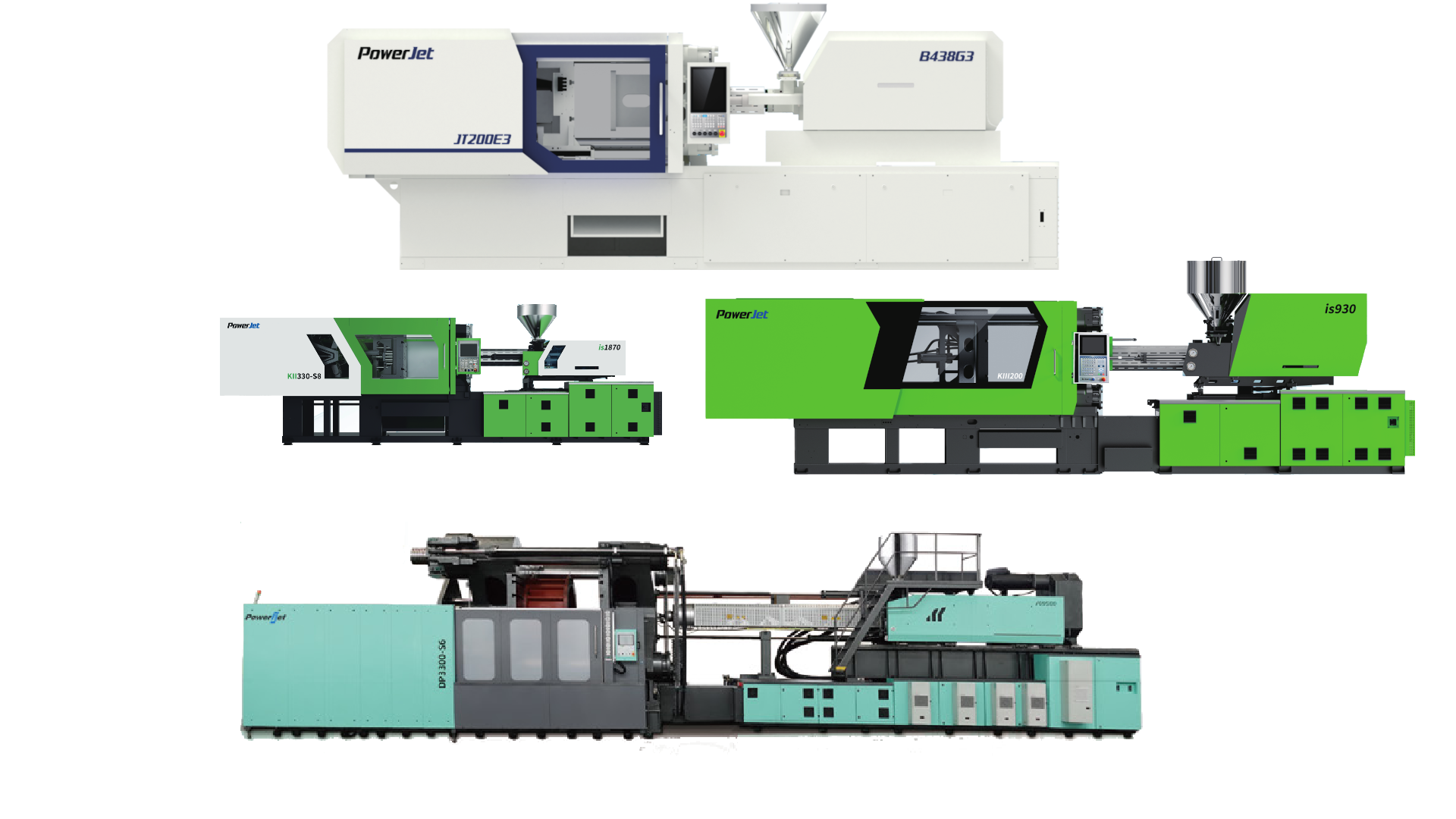
Buying an injection moulding machine rarely starts from a blank sheet. There is a product or product family, there is a mould for it (or one in the making), there is a production hall with a given floor area, power supply and compressed-air network, and there is a production plan that tells you how many parts you need to get out of it per shift.
The catalogue does not describe any of that. The catalogue describes a generic machine under generic conditions, with figures the manufacturer chose so that its own machine types can be compared with one another. That is perfectly fine — it is just not the same as your task.
The five considerations below try to cover that gap. They do not recommend a machine, and they do not replace a technical consultation with the manufacturer. They collect what is worth thinking through before the quotations become comparable.
What this article does not coverCalculating the required clamping force (the product of the projected area and the melt pressure actually developed in the mould cavity) is a topic in its own right, and we will return to it in a separate article. There, the question is how big a machine you need. Here, it is what kind.
Consideration 01: What does the machine need to be able to do — and what not?
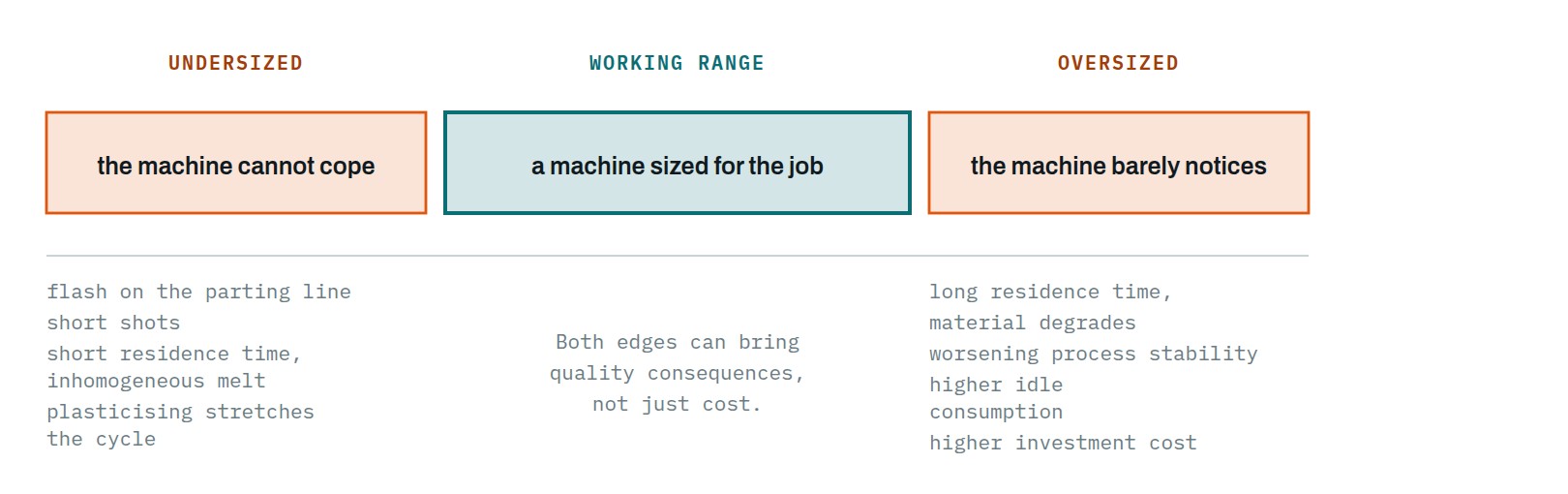
One of the most expensive mistakes in machine buying is not choosing the wrong brand. It is sizing the specification to your sense of security rather than to the task. "Better make it bigger, so it will still do later on" is a logical sentence, and often a bad decision.
Oversizing does not just cost money. If the shot occupies too small a fraction of the barrel capacity, the material is heated over many cycles, which leads to degradation and colour problems with heat-sensitive materials. That is no longer a cost — it is a quality defect. The same goes for undersizing: short residence time, an inhomogeneous melt, and if plasticising does not fit within the cooling time, then it is the plasticising that stretches the cycle, not the cooling.
The energy class is not your electricity bill
A good example of how little a catalogue figure says about your own situation. The energy efficiency class of injection moulding machines is based on the EUROMAP 60.1 recommendation. This is a precisely defined measurement with a precisely defined scope — narrower than most readers would expect: it evaluates the drives performing the main movements, the heating of the thermally insulated barrel, and the control cabinet and control system.
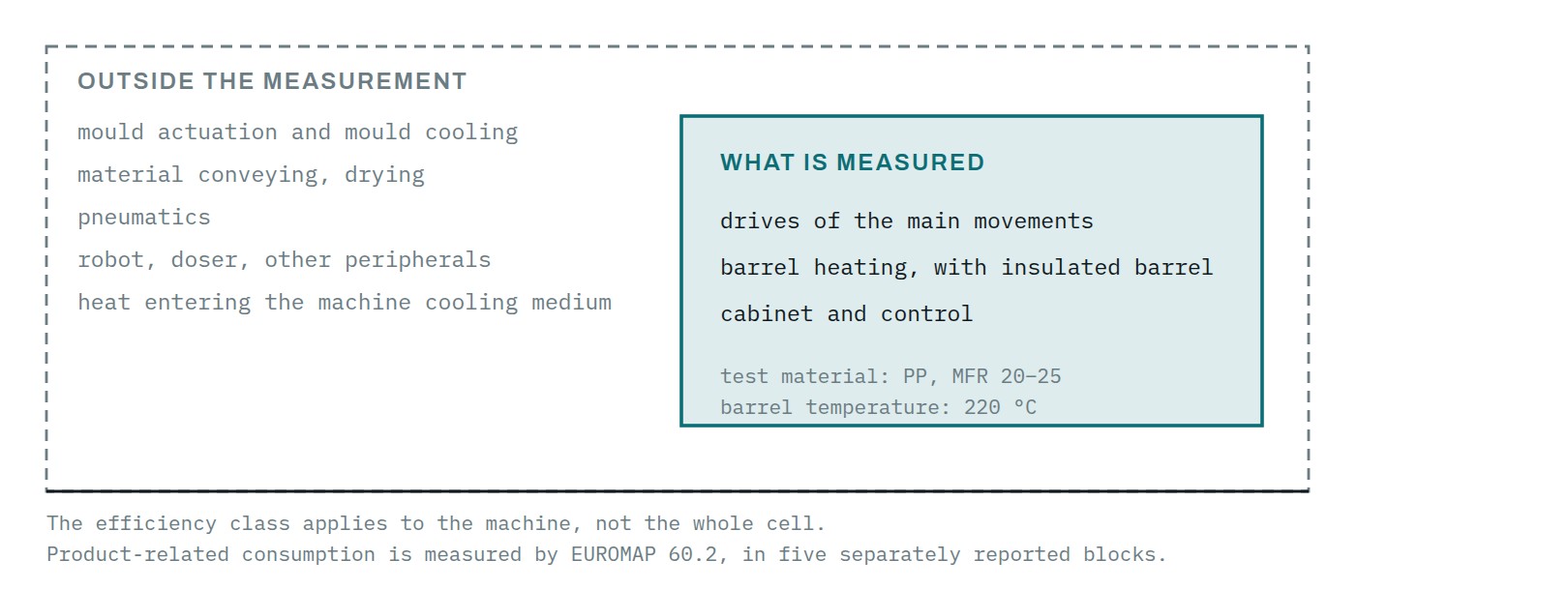
The efficiency class is therefore meant for comparing two machines of comparable size against each other. If you want to know real consumption, the product-related measurement according to EUROMAP 60.2 is the right tool: it breaks consumption down into five separately reported blocks, and it runs with the actual product and the material you actually use. If there is a way to do so, it is worth requesting this, for instance as part of the trial moulding or the acceptance test, because it tells you something about the actual operating cost. Even this does not give the full picture: the energy demand of externally supplied cooling water, compressed air and vacuum is not automatically included either.
We have written a separate overview of the EUROMAP recommendations — which number means what, and why they are recommendations, not standards: EUROMAP recommendations: what does each number mean?
Worth thinking through
- Which product will the machine produce for the most hours? That is what the specification should be sized to, not the rarely occurring extreme.
- If, for a future larger product, the clamping unit and the machine's geometric dimensions still fit, could the application be handled with a different barrel-and-screw unit instead of a machine a whole size class larger?
- Which recommendation was the energy figure measured to? Can a measurement be requested with your own mould?
Consideration 02: Clamping force is a number — the mould is geometry
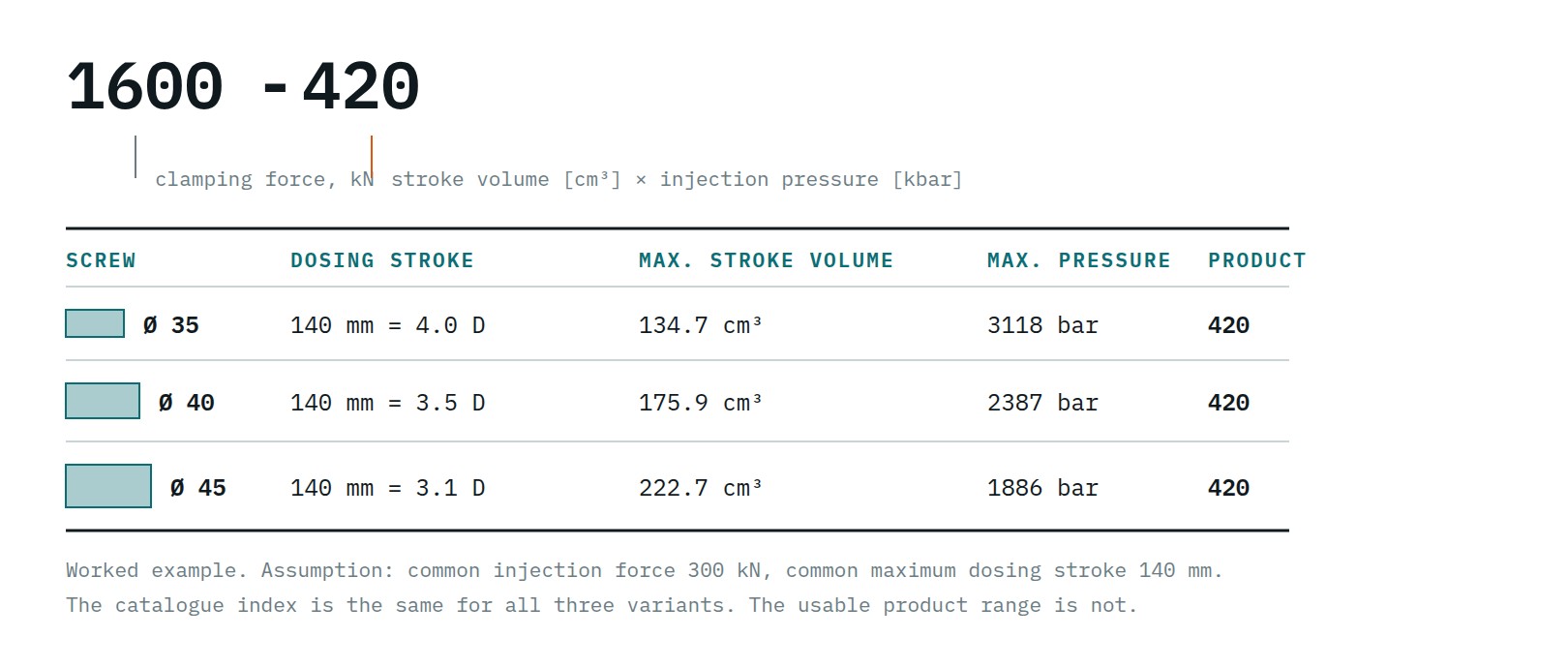
The machine-type designation according to EUROMAP 1 consists of two numbers. The first is the clamping force in kilonewtons; the second characterises the injection unit: the product of the maximum stroke volume (cm³) and the maximum injection pressure (kbar). A machine designated "1600-420" therefore delivers 1600 kN — roughly 160 tonnes — of clamping force.
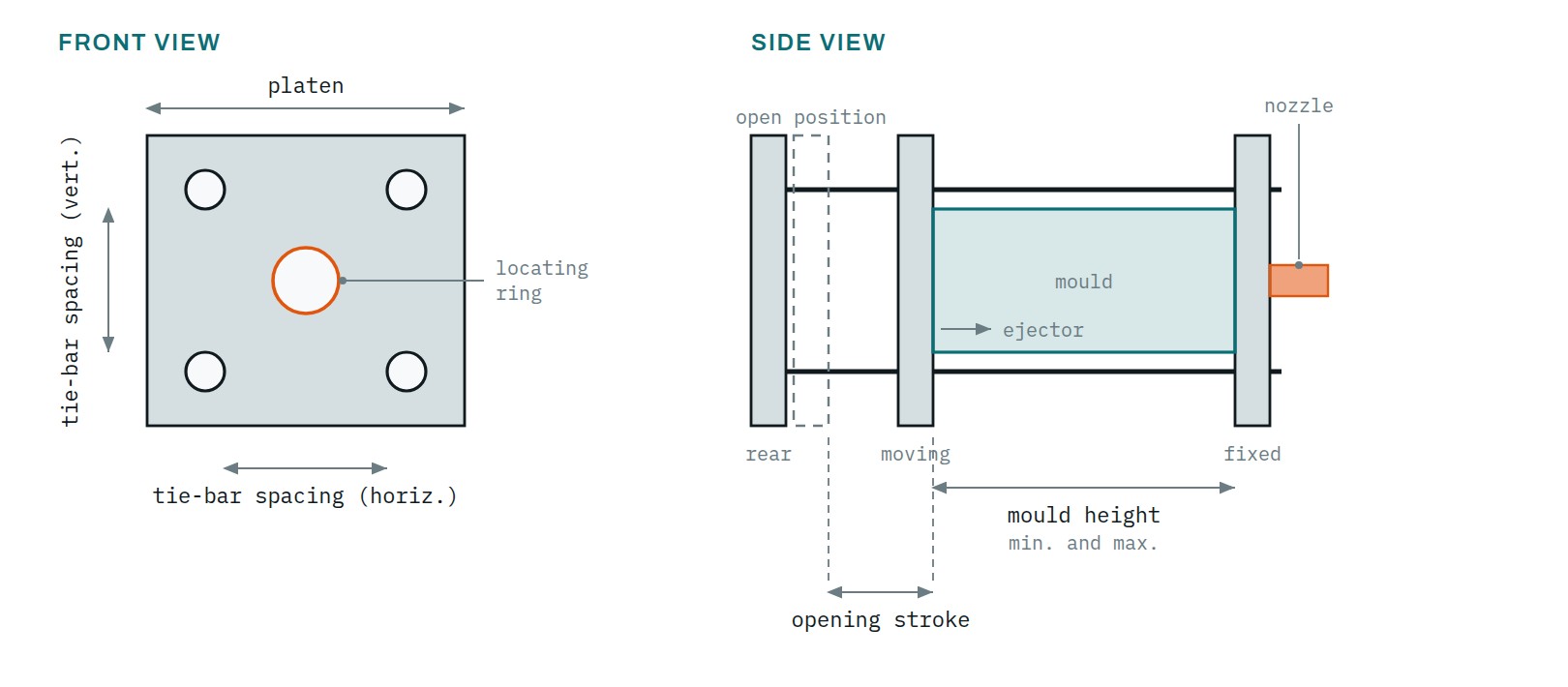
These two numbers say nothing about whether your mould will fit. Mountability is decided by a separate group of data, which is there on every manufacturer's data sheet — just not on the first page:
- Tie-bar spacing, horizontal and vertical. The mould has to pass between the tie bars. If its size means it cannot be brought in between them, tie-bar pulling may be needed. Tie-bar pulling can be justified by more than mould width, though: side-entry mould changing, a low hall ceiling or the crane's limited lifting height can also make it necessary, because in those cases there is not enough room to insert the mould from above. You mostly encounter this solution on larger machines.
- Platen size, the hole pattern and the diameter of the locating ring.
- Minimum and maximum mould installation height. Everyone watches the maximum, rarely the minimum: a mould thinner than the machine's minimum installation height cannot be clamped directly — a spacer or adapter plate may be the solution in a given case. This is exactly what comes up with old, small moulds.
- Opening stroke. It has to cover the distance needed to remove the part, and if a robot works on the machine, also the gap through which the robot arm enters.
- Ejector force and ejector stroke, as well as the location of the ejector holes.
- The permissible weight of the moving mould half. A catalogue figure, and a real limit with heavy moulds.
If you are transferring an existing mould inventory to the new machine, these data are not part of a general check but a comparison to be carried out mould by mould. A single mould that does not fit is enough for the investment to fail to replace what it was supposed to replace.
Worth thinking through
- Make a list of your existing moulds by installation height, size and weight, and ask for written confirmation that every one of them will go onto the machine.
- How will the mould get into the machine? Measure the crane's hook height and the hall's clear height above the machine, because that decides whether the mould can be inserted from above or tie-bar pulling is needed.
Consideration 03: The injection unit's catalogue number is not about the screw
This is where most of the misunderstandings live. The second number in the machine designation — the product of stroke volume and injection pressure — does not by itself tell you which screw is in the machine. Several screw diameters can belong to the same injection unit, and the index remains similar for all of them. Within a given injection-unit and drive configuration, the available maximum injection force is essentially fixed — only the screw and barrel are swapped: with a smaller diameter you get higher pressure at a smaller volume, with a larger diameter a larger volume at lower pressure.
The same catalogue number can therefore hide several substantially different screw configurations. If a quotation only states the machine-type designation, the suitability of the specific screw variant cannot yet be judged from it. This is the point where a well-put question can gain you the most, regardless of brand.
The shot weight is quoted for polystyrene
Most manufacturers traditionally state the maximum shot weight for polystyrene. For your own material you have to convert it using the ratio of melt densities, and the difference is not negligible: converted to polyolefins, the deliverable weight is noticeably smaller than the value in the catalogue. If the shot weight is close to the limit anyway, this conversion can even make a larger injection unit necessary.
There is no single accepted rule for the utilisation window
On the question of what fraction of the barrel capacity the shot should ideally occupy, several mutually differing recommendations are in circulation. We are not listing them so that you pick one, but so that it becomes visible: anyone presenting a single range as the truth is oversimplifying.
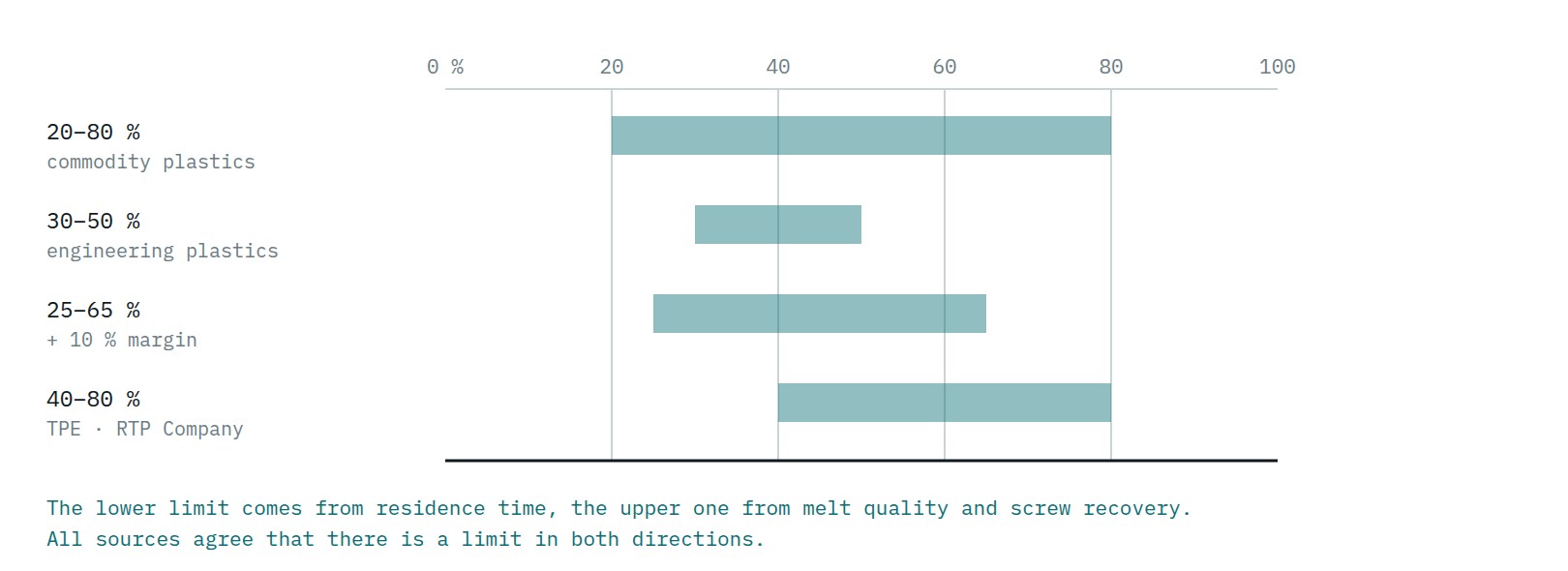
For the metering stroke there is also a more concrete design guideline: the optimum operating range of the metering stroke is roughly between one and three screw diameters, and above four screw diameters maximum process stability can no longer be guaranteed. This is a well-measurable number that you can check when requesting a quotation.
Worth thinking through
- Ask for data on each screw variant separately: maximum stroke volume, maximum injection pressure, maximum injection flow rate (cm³/s) and plasticising rate. With thin-walled parts, the injection flow rate and the fill time decide at least as much as the pressure.
- State your own material and ask for the shot weight converted to it, not the one quoted for polystyrene.
- Ask about the planned metering stroke expressed in screw diameters (
stroke / D), and whether the plasticising fits within the planned cycle time.
Consideration 04: You are not buying a machine — you are buying a cell
This is the most easily grasped and most frequently underestimated consideration. The machine on its own produces nothing. To get a product out of it, you need material supply, drying for hygroscopic (moisture-absorbing) materials, mould temperature control, cooling, compressed air, most likely a take-out robot or manipulator, and quite probably a granulator too.
A substantial part of these does not appear in the machine quotation, yet it is part of the project. It matters a great deal when it turns out something is missing — and who engineers all of it together with the machine.
- Cooling. The machine and the mould circuit do not necessarily require the same temperature level. On a hydraulic machine, oil cooling, hopper (feed-throat) cooling and mould temperature control can mean differing temperature and volume-flow requirements, and the chiller is not sized by the machine's rated power. We worked this through in a separate article: Industrial chiller sizing: how do you calculate the required cooling capacity?
- Temperature control. The temperature stability of the mould circuit shows up directly in dimensional accuracy. Water or oil, and at what temperature — that depends on the product.
- Compressed air. The machine's pneumatic functions, the robot's vacuum system and mould air-blast together can add up to a consumption that exhausts your existing compressor capacity. It is worth requesting the required air quantity in Nl/min or Nm³/h together with the corresponding operating pressure, rather than deciding on a "we have enough air" basis.
- Material supply and drying. The hourly material consumption is given by the shot weight and the cycle time, and this number changes together with the machine choice. If the raw material requires drying, this is the figure that, together with the material type, has to be given to the dryer supplier: the dryer is sized on the basis of the material's prescribed drying time and temperature, the dew point and the required dry-air volume flow rate. If drying takes place in a separate drying bin and a vacuum loader supplies the machine from there, then a multi-hour drying stock does not have to be stored above the machine. With machine-mounted or beside-the-press drying, on the other hand, the prescribed residence time has to be ensured in that particular drying bin. The material conveying itself has to be sized in both cases: for the loader, the required hourly material flow, the conveying distance and the material's properties are what count.
- Part removal. For fast, repetitive take-out tasks, a linear robot is often the practical choice. For tasks demanding greater spatial freedom, multiple orientations or beside-the-press operations, a six-axis robot is often advantageous. We covered the machine-side interface in detail in the EUROMAP overview.
- Installation. Foundations or floor load-bearing capacity, the hall's clear height for placing the material supply above the machine, the crane or forklift capacity needed for mould changes, the cross-section of the power feed.
Worth thinking through
- Ask for the machine's complete connection requirements on one sheet: electrical power, cooling-water volume flow and temperature level per circuit, compressed-air quantity and pressure.
- Ask for a separate quotation line for the auxiliary equipment, so it is visible what is in the price and what is not.
- Ask who is responsible for coordinating the cell as a whole if the machine and the auxiliaries come from different suppliers.
Consideration 05: Who carries the risk?
The price of the machine and the cost of the investment are not the same thing. A significant part of the difference consists of items that do not depend on the machine's specification, but on whom you buy it from and who manufactured it. This can hold some of the largest variation in the entire purchase — and it is what gets talked about the least.
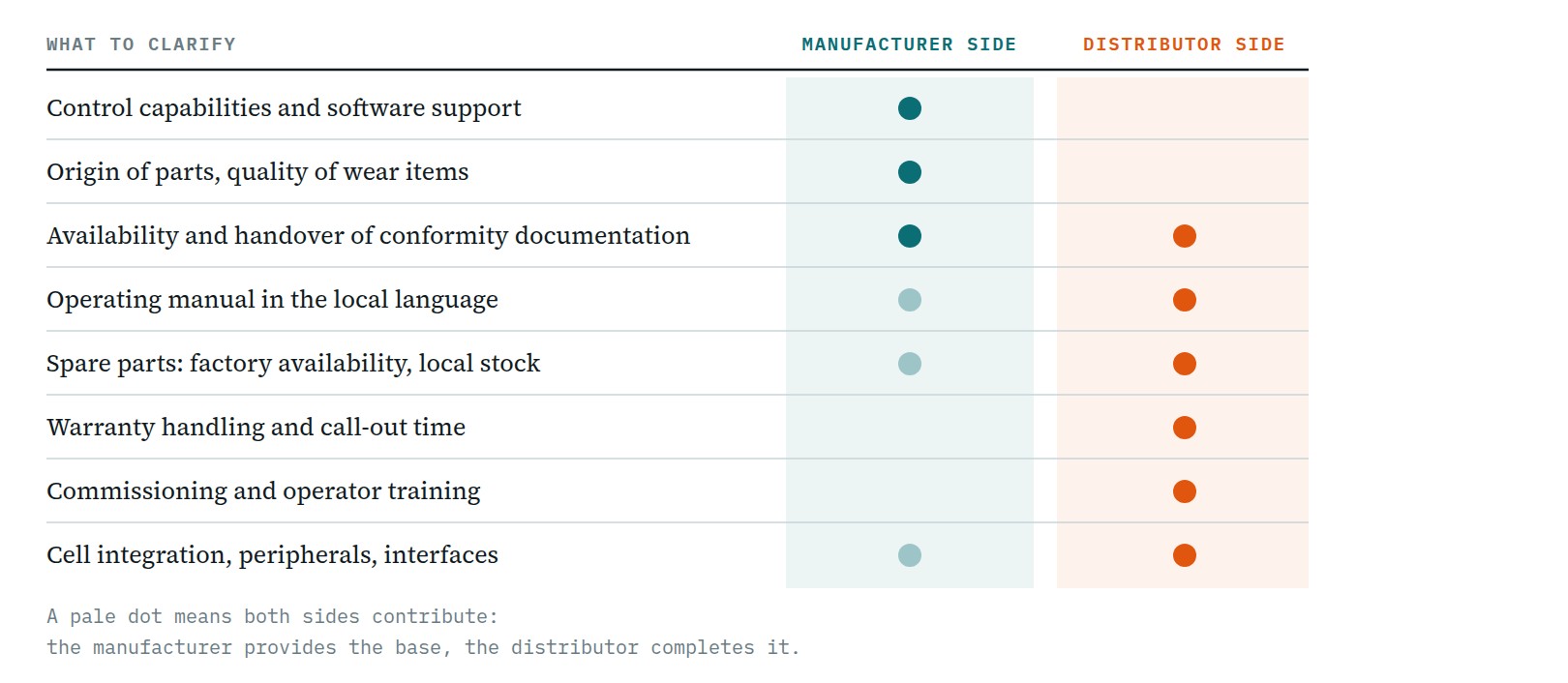
There is genuine competition between European and Asian machines on the Hungarian market, and that decision really is part of the picture. Two things are worth adding, though. One is that the variation does not run only along the line of origin. Between two manufacturers from the same country there can also be significant differences in control system, component quality, documentation and in how present they are on the European market. The other is that the differences between distributors can be significant too. The same machine is an entirely different investment depending on whether there is domestic service, a spare-parts stock and commissioning behind it — or just an invoice.
So the useful question is not which country's machine is better, but who handles the items below, and whether that is in the contract. Not one item on the list is theoretical: each becomes visible when there is a problem.
The interfaces you will need in two years' time
Integrability rarely comes up at the first request for quotation, because at the moment of the investment there is no robot or manufacturing execution system yet. Retrofitting, however, is typically more expensive. The practical question is simple: if the machine does not get a robot interface today, what does it cost to fit one later — and if the plant introduces data collection in two years' time, can the control system supply data according to a standardised information model? We went through the relevant recommendations in the EUROMAP overview.
Worth thinking through
- Ask about the lead time for spare-parts supply, and whether there is a domestic stock of wear parts.
- Ask about commissioning, training and the warranty-handling process, including the call-out time.
- Ask how many machines of this type are already operating in Hungary or in the region, and whether one of them can be visited.
- Ask about the control system's software update policy and its supported lifetime.
In summary
| Consideration | The wrong question | The right question |
|---|---|---|
| 01 What kind of machine | How big a machine can I afford? | What will the machine produce for the most hours, and what is the workable range for that? |
| 02 Geometry | Is the clamping force enough? | Does every existing mould fit — by size, height and weight? |
| 03 Injection unit | What is the machine's type designation? | With which screw, and what does that deliver converted to my own material? |
| 04 Cell | How much does the machine cost? | How much does the working cell cost, and who coordinates it? |
| 05 Risk | Which country's machine is better? | Of the eight items, which does the manufacturer handle, which the distributor, and what is in the contract? |
None of these questions is complicated, and none is awkward to put to a supplier. Experience shows that serious suppliers welcome this kind of enquiry, because these questions can be answered precisely — and after a quotation built on precise answers, there is less often a dispute at handover.
Where we can help
CIS distributes injection moulding machines, auxiliary equipment and robots alike. The bottom five items of the list above are exactly the area where a distributor can add to the machine — or fail to.
- PowerJet injection moulding machines: machine-type and screw selection sized to your specific product.
- Samfacc linear take-out robots and Borunte six-axis robots: for part removal and for more complex tasks, including machine-side integration.
- MARSE temperature control units and iTech industrial chillers: for mould temperature control and machine cooling.
- Documentation, commissioning, training, spare-parts supply: as CIS's domestic representation, we coordinate these.
If you approach us with a specific product or an existing mould inventory, we can go through the five considerations above with your own data — before you even request a quotation.
Take the essentials with you!
Enter your details and we'll email you the download link.
Request a tailored quote!
Fill out the online configurator and our experts will send a tailored offer within 24 hours.
Injection moulding configurator →Got a question? We can help!
Get in touch and our experts will help you choose the right solution.
Contact →