Industrial cooling basics – which solution fits your plant?
Cooling tower, dry cooler, chiller — the names sound familiar, but when should you pick which? This guide summarises the five most important industrial cooling technologies so that there are no surprises with your next investment.
1. Introduction – Why is industrial cooling important?
Industrial liquid cooling systems are indispensable elements of modern manufacturing and process technology. From injection moulding through extrusion blow moulding to CNC machining and server cooling, countless applications require accurate and reliable temperature control.
The consequences of inadequate cooling can be severe: reduced product quality, machine damage, downtime, higher scrap rates and wasted energy. Choosing the right cooling technology is therefore a strategic decision that influences operating costs and productivity in the long term.
Typical fields of application
Plastics injection moulding – mould and hydraulic-oil cooling
Extrusion blow moulding – mould, oil and MOOG hydraulic cooling
Food industry – pasteurisation, fermentation, cold storage
IT / data centre – server cooling, thermal management of UPS units
Building services – comfort cooling in office buildings and shopping centres
The 5 main cooling technologies
In this article we present the following five fundamental industrial liquid-cooling types in detail — with operating diagrams and a comparison matrix — and then introduce the ECO hybrid chiller series, which combines compressor cooling and free cooling in a single unit.
2. Cooling tower
Operating principle
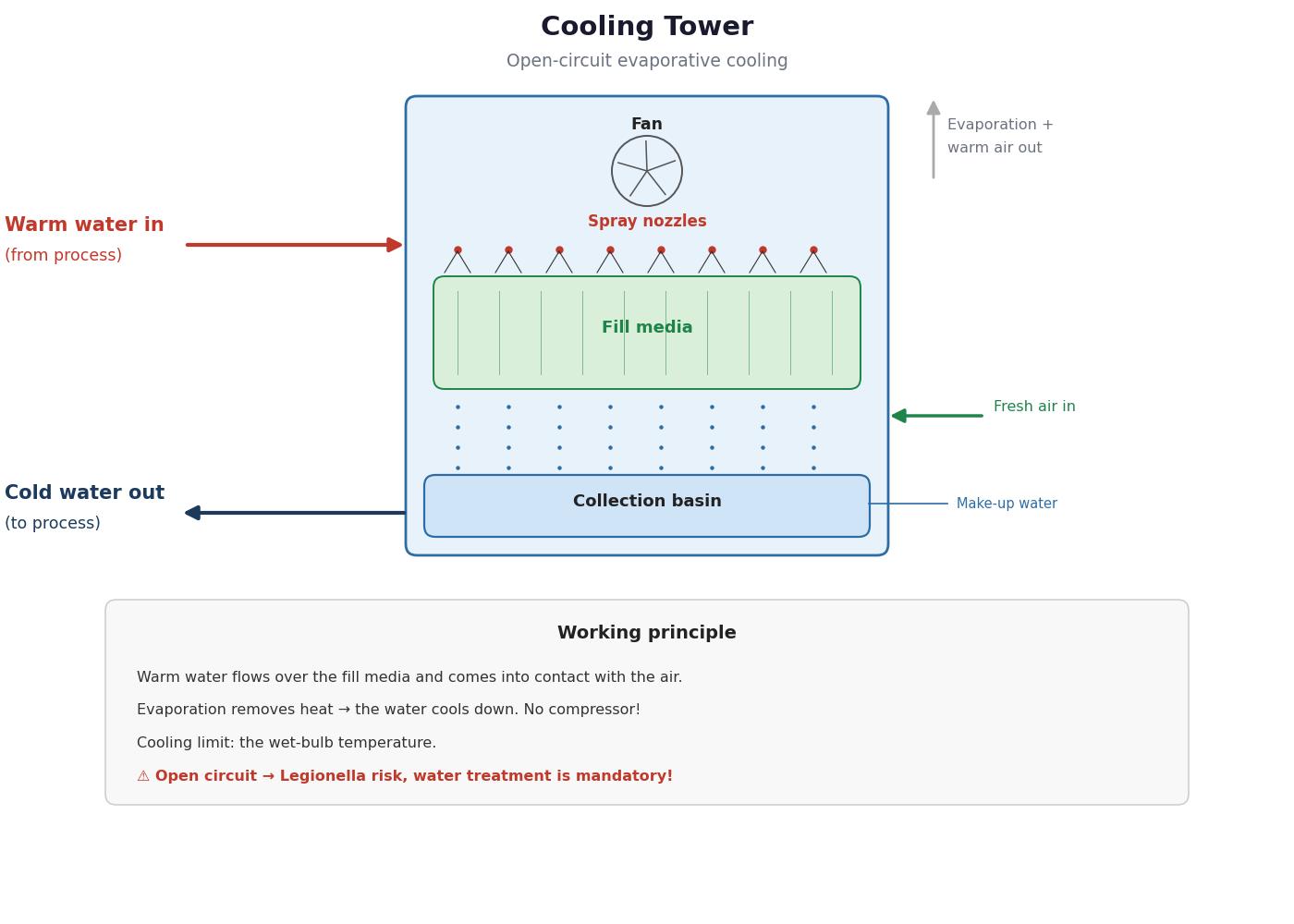
The cooling tower is the oldest and simplest industrial cooling solution. It works on the physical principle of evaporation: warm water is sprayed across a fill medium, where it comes into contact with air. Part of the water evaporates, drawing heat from the remaining water, which is then collected — cooled — in the lower basin.
The cooling limit is the wet-bulb temperature, which the tower can approach but never reach. The typical approach is 3–7 °C.
The performance of a cooling tower depends on humidity, not just on air temperature. In dry air it is much more efficient; in humid air it is barely better than a dry cooler.
Operating principle of a cooling tower
Advantages
Extremely low energy consumption – the most economical cooling method
High cooling capacity in a compact footprint
No refrigerant – no F-gas obligations
Disadvantages
Open system: water can become contaminated (dust, algae, bacteria)
Legionella risk – periodic water treatment and testing are mandatory
Significant water consumption (evaporative loss + water replacement)
Cannot cool below the wet bulb – at summer peak the leaving water is around 28–33 °C
Frost protection required in winter
Limescale deposition – regular water treatment is necessary
3. Dry cooler / free cooler
Operating principle
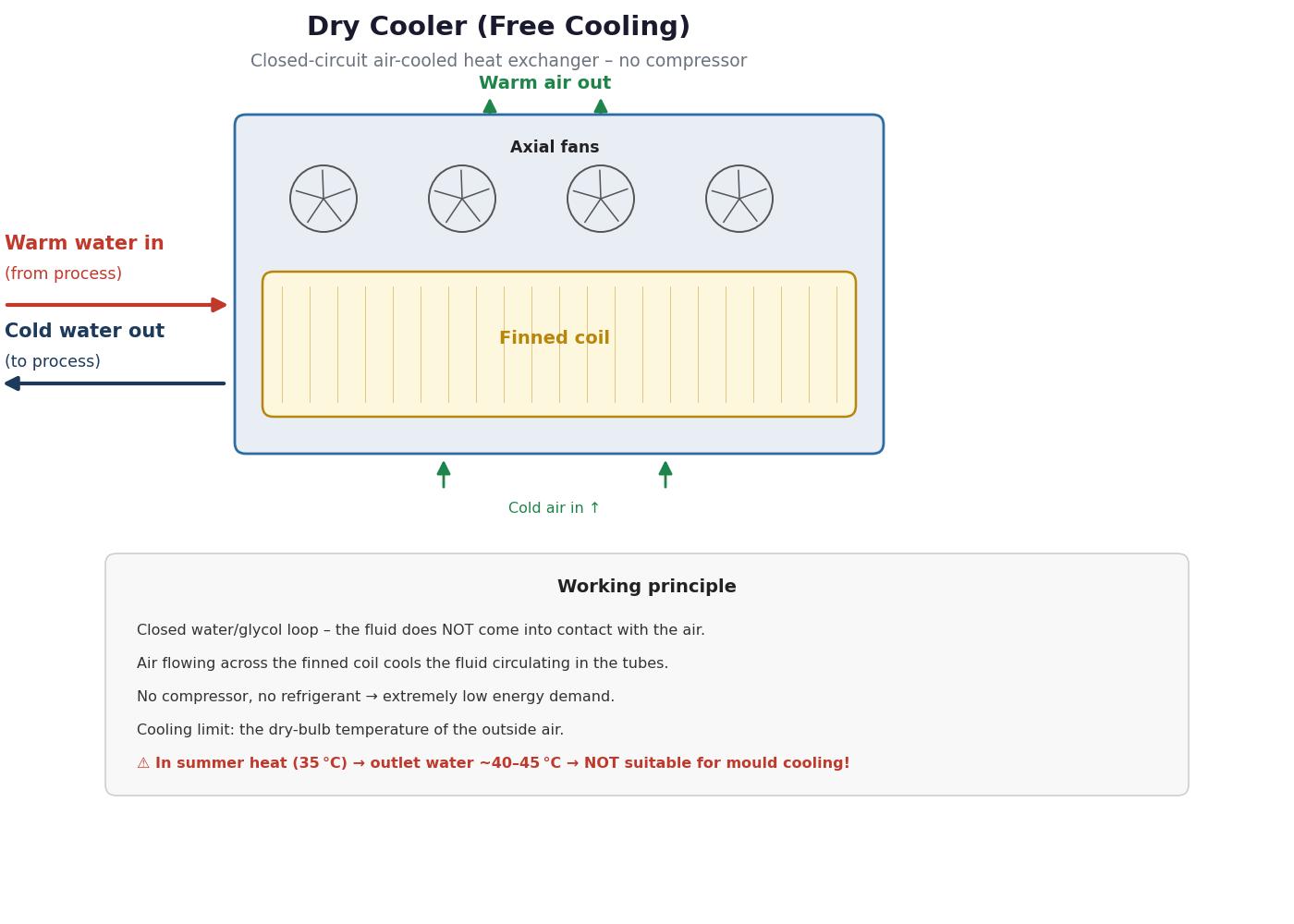
The dry cooler is a closed-loop air-cooled heat exchanger. The warm fluid (water or water-glycol mixture) flows through a finned coil while axial fans blow air across the heat exchanger. The fluid and the air do not come into direct contact.
The cooling limit is the outdoor dry-bulb temperature. The leaving fluid temperature is always higher than the ambient air — typically by +5–10 °C.
The dry cooler is tied to the dry-bulb temperature. In a Hungarian summer (35 °C) the leaving water is 40–45 °C — for many applications this is no longer sufficient.
Operating principle of a dry cooler / free cooler
Advantages
Closed loop – no contamination, no Legionella risk
Zero water consumption
No refrigerant – no F-gas obligations
Minimal maintenance (filter cleaning, fan bearings)
Excellent efficiency in winter, spring and autumn
Disadvantages
In summer it cannot cool sufficiently – the leaving fluid temperature stays above the air temperature
Large physical footprint due to the heat-exchanger area
Frost protection required (glycol mix), which reduces heat transfer
If a leaving temperature below 20 °C is required → in summer it is not adequate on its own
4. Adiabatic cooler
Operating principle
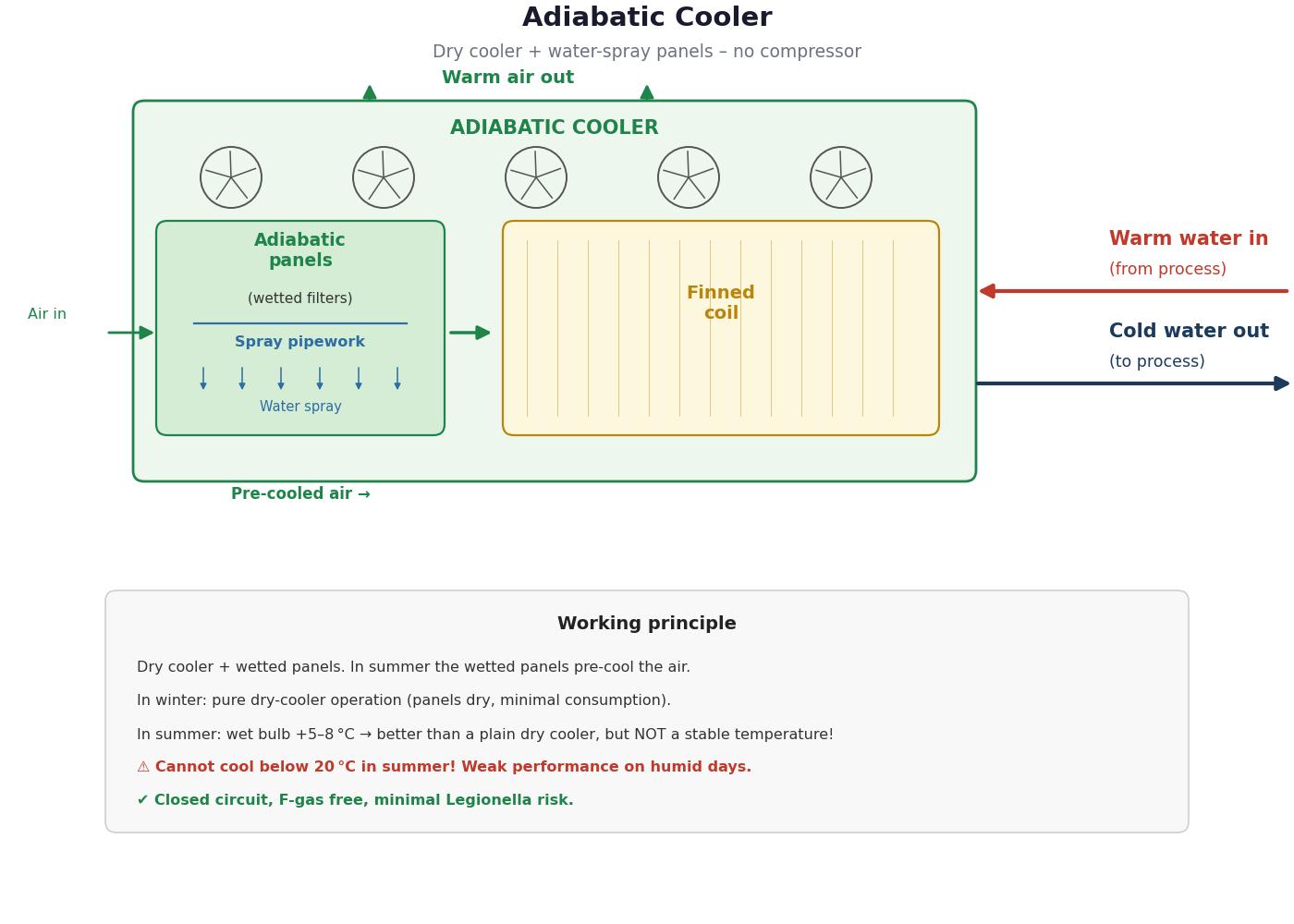
An adiabatic cooler is a combination of a dry cooler and an evaporative system. It essentially operates as a dry cooler, but when the ambient air is too warm for efficient cooling, adiabatic pads (wetted filter panels) are activated.
The air passing through the wetted panels cools down (through the heat-absorbing effect of evaporation), and this pre-cooled air then flows across the finned coil. With this method the summer performance of the dry cooler improves significantly, while in winter and the transitional seasons the unit operates as a pure dry cooler.
The adiabatic cooler approaches the wet-bulb temperature — but it cannot guarantee a stable 15–20 °C leaving temperature at summer peak. In a Hungarian summer (35 °C, 50% humidity) the leaving water is around 28–33 °C.
Hybrid operation of an adiabatic cooler
Comparison – Dry cooler vs. adiabatic vs. cooling tower
Period
Humidity
Dry / wet bulb
Dry cooler
Adiabatic
Cooling tower
Note
Spring
45%
20 °C / 13 °C
~27 °C
~20 °C
~18 °C
All good
Summer, dry
30%
33 °C / 20 °C
~40 °C
~26 °C
~24 °C
DC poor!
Summer, humid
60%
33 °C / 26 °C
~40 °C
~33 °C
~30 °C
Humidity hurts!
Heatwave
40%
35 °C / 23 °C
~42 °C
~30 °C
~28 °C
Tower wins
Autumn
55%
15 °C / 10 °C
~22 °C
~16 °C
~15 °C
All good
Winter
75%
2 °C / 0 °C
~9 °C
~7 °C
~5 °C
Min. difference
Tip: The best compromise for many industrial applications is the adiabatic dry cooler: closed loop (no Legionella), F-gas-free, and even in summer it delivers 25–33 °C water — perfect for oil cooling and condenser cooling. But if you need a guaranteed water temperature of 15–25 °C → a chiller is required.
5. Air-cooled chiller
Operating principle
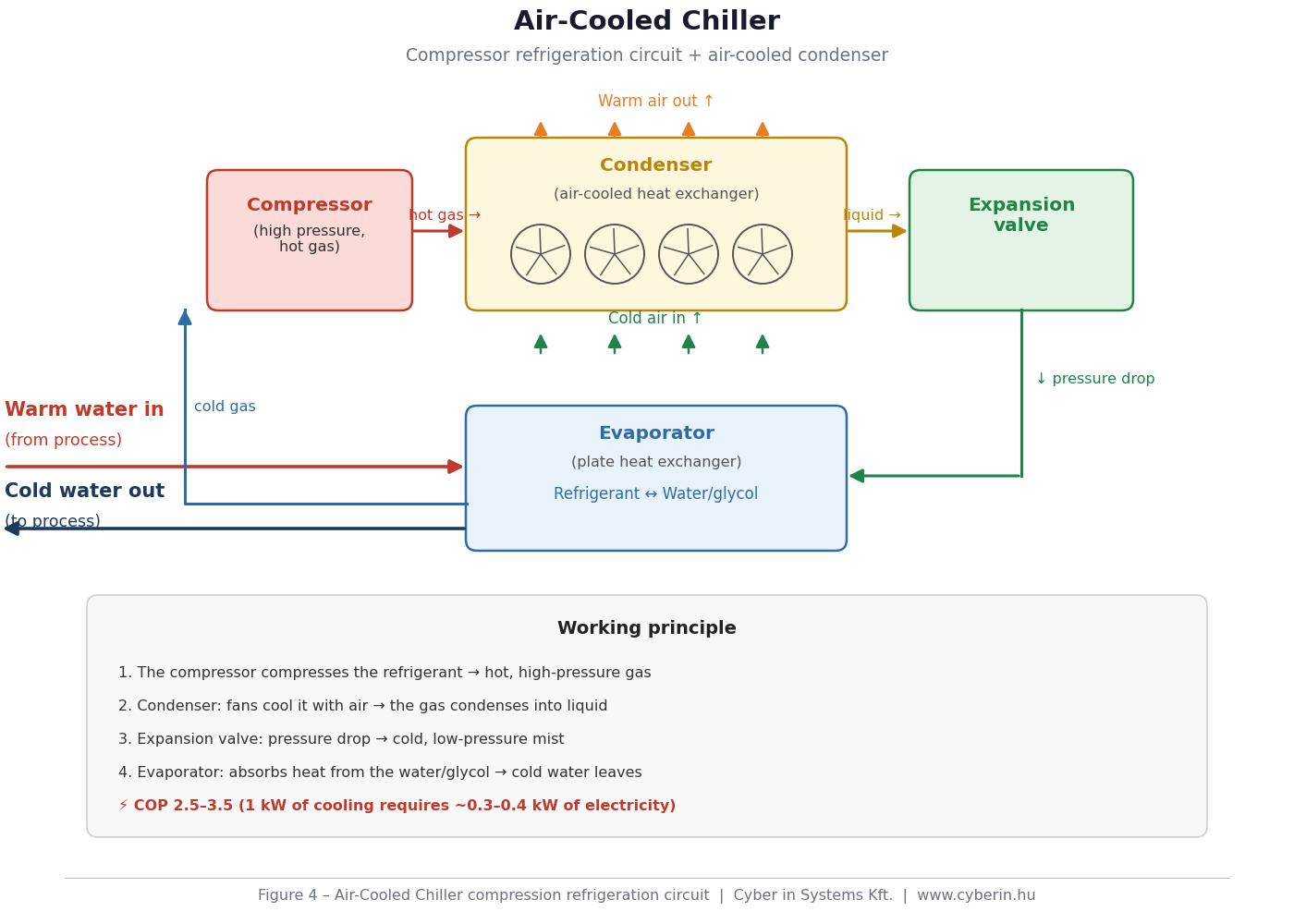
The air-cooled chiller is the most common industrial liquid-cooling type. It contains a compressor refrigerant circuit in which refrigerant (e.g. R-410A, R-454B, R-134a) is circulated. The compressor compresses the refrigerant, which gives off heat to the air in the condenser (using fan-equipped heat exchangers); after passing through the expansion valve the refrigerant undergoes a pressure drop and absorbs heat from the process fluid in the evaporator.
This technology can produce a leaving fluid temperature as low as 5 °C, or even below freezing point, regardless of the outdoor temperature.
Compressor refrigerant circuit of an air-cooled chiller
Advantages
Precise temperature control – accurate to within ±0.5 °C
Independent of ambient temperature – cools steadily even in summer
Compact, all-in-one unit – no cooling tower required
Quick installation – plug & play (water + electrical connection)
Closed loop – no water consumption, no Legionella
Disadvantages
Higher energy consumption due to the compressor (COP 2.5–3.5)
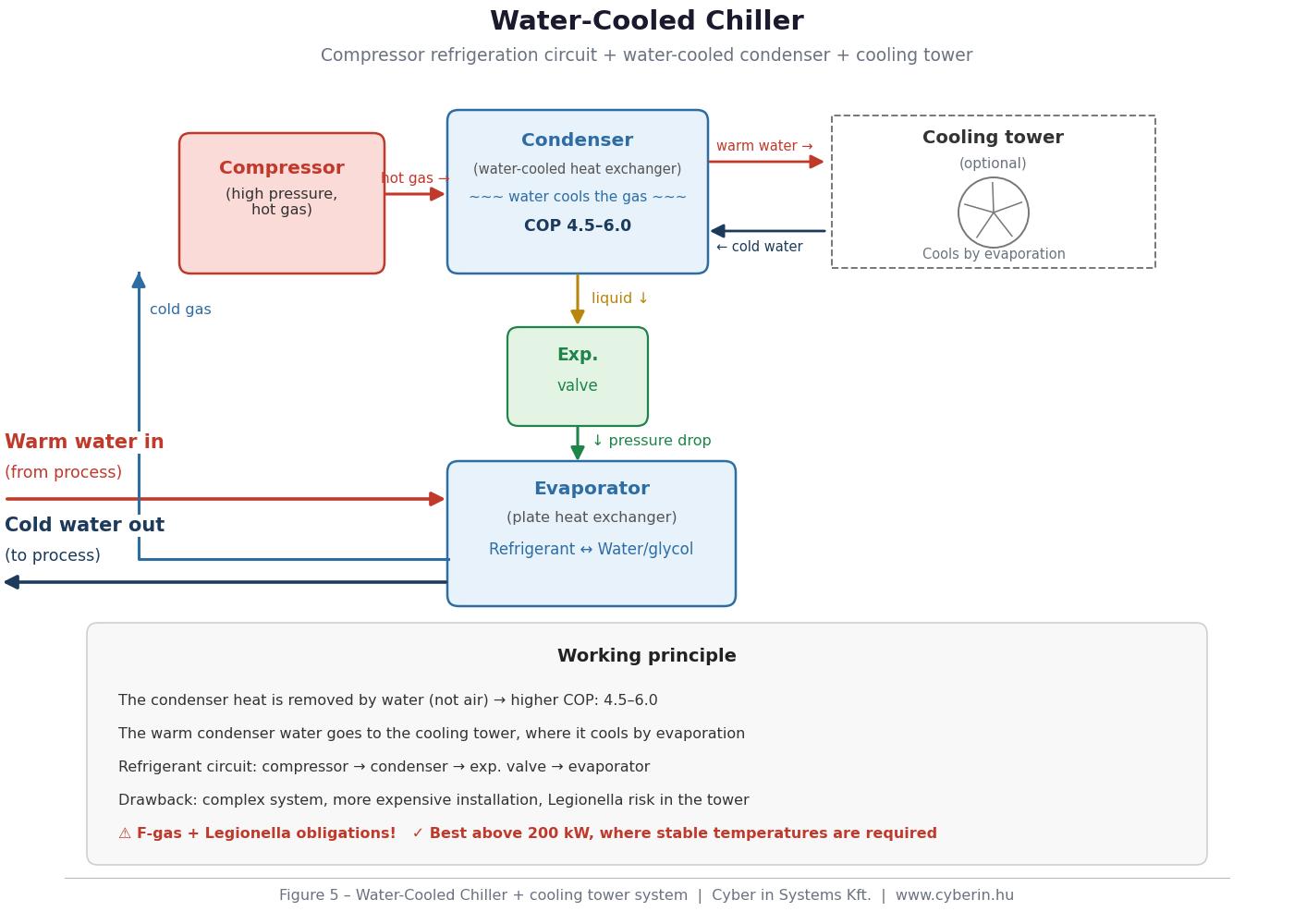
The water-cooled chiller is based on the same compressor refrigerant circuit as the air-cooled chiller, but the condenser heat is removed not by air but by water. This requires a separate water circuit between the condenser and a cooling tower (or other heat-rejection device).
The water-cooled condenser (shell-and-tube or plate heat exchanger) provides significantly more efficient heat transfer than the air-cooled version, so the COP of the water-cooled chiller is higher: typically 4.5–6.0. The price, however, is also higher because of the cooling tower's installation and operation.
Water-cooled chiller + cooling tower system
Advantages
Highest energy efficiency among chillers (COP 4.5–6.0)
Excellent at high capacities (>200 kW)
Stable operation even on hot summer days
Disadvantages
Complex system – chiller + cooling tower + two water circuits + water treatment
High capital cost (cooling tower, pipework, pumps)
Cooling-tower maintenance: water treatment, Legionella prevention
F-gas obligations because of the refrigerant
7. Comparison matrix
The table below summarises the most important characteristics of the five main cooling technologies side by side:
Aspect
Cooling tower
Dry cooler
Adiabatic
Air-cooled chiller
Water-cooled chiller
Leaving temp. (summer)
28–32 °C
40–45 °C
25–30 °C
5–20 °C
5–15 °C
Leaving temp. (winter)
5–15 °C
5–15 °C
5–15 °C
5–20 °C
5–15 °C
COP / EER
20–40
20–40
15–30
2.5–3.5
4.5–6.0
Capital cost
Medium
Low
Medium-High
Medium
High
Operating cost
Low
Very low
Low
Medium-High
Medium
Water consumption
High
Zero
Moderate
Zero
High
F-gas obligation
None
None
None
YES!
YES!
Legionella risk
YES!
None
Minimal
None
YES! (tower)
Noise level
Medium
Medium
Medium
High
Low (indoor)
Maintenance
High
Low
Medium
Medium
High
Installation
Medium
Simple
Medium
Simple
Complex
Typical size
50 kW – MW
10 kW – 2 MW
20 kW – 2 MW
5 kW – 1.5 MW
100 kW – 10 MW
Legend: COP = coefficient of performance (higher is better)
8. Decision aid – Which one should I choose?
The choice of the right cooling system depends on the answers to the following key questions:
What temperature do you need?
If a stable temperature of 5–15 °C is required even in summer → chiller (air-cooled or water-cooled)
If 25–35 °C is acceptable → cooling tower, adiabatic or dry cooler
If cooling is sufficient in winter/autumn and not critical in summer → dry cooler
How important is energy efficiency?
Maximum savings → dry cooler or cooling tower (but limited summer temperature!)
Good compromise → hybrid chiller with free cooling (e.g. ECO series) — 30–60% savings!
Is being F-gas-free important?
If you want to avoid F-gas registration → cooling tower, dry cooler, adiabatic
If it is not a concern → air- or water-cooled chiller (or hybrid)
But what if you want both: a guaranteed water temperature in summer AND low energy costs in winter?
The answer is a hybrid chiller — and within that, the ECO series.
9. ECO Series – The best of both worlds
What is a hybrid chiller?
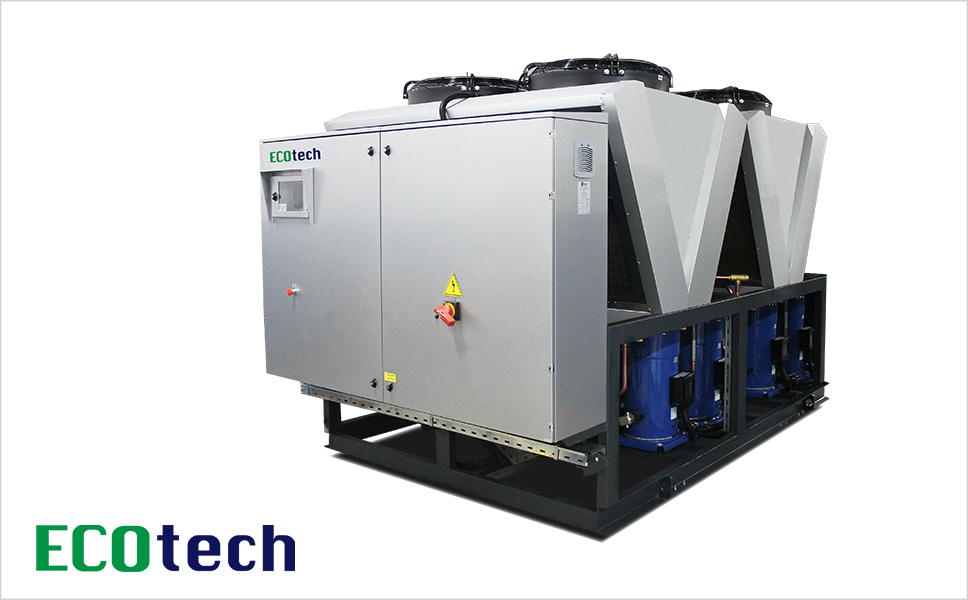
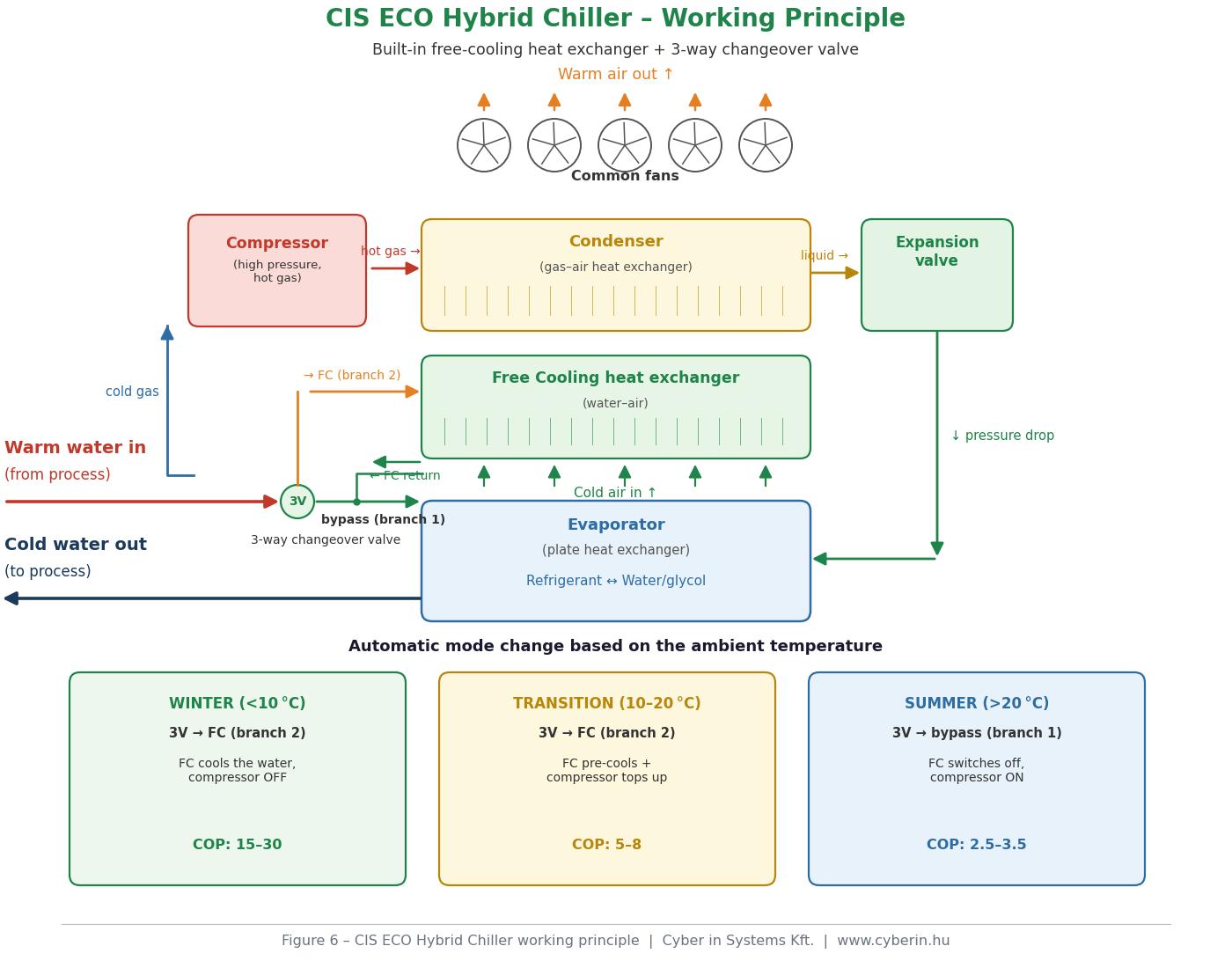
The hybrid (free-cooling) chiller combines two technologies in a single unit: a compressor refrigerant circuit and an integrated free-cooling (dry-cooler) section. The control system automatically selects the operating mode based on the ambient temperature.
Operating principle of the ECO hybrid chiller – with 3-way diverting valve
Winter mode (approximately November – March)
When the outdoor temperature is low (<10–15 °C), the compressor SWITCHES OFF. The unit cools using only its fans, like a dry cooler. The energy consumption is then limited to that of the fans: a fraction of the consumption of compressor mode.
Transitional mode (spring, autumn)
The free cooler and the compressor work TOGETHER. The free-cooling section pre-cools the water, and the compressor only removes the residual heat. This significantly reduces the load on, and consumption of, the compressor.
Summer mode (approximately June – August)
On hot days the compressor takes the leading role, but the free cooler still helps — particularly at night and during cooler hours. The leaving water temperature is stable and guaranteed, in contrast to an adiabatic cooler.
Advantages of the ECO series
Guaranteed leaving water temperature: 5–20 °C, regardless of season
30–60% annual energy savings compared with a conventional air-cooled chiller
A single unit – no need for separate dry cooler + chiller + control system
Automatic mode switching – no human intervention required
Extended compressor life – it does not run in winter, so fewer operating hours
Plug & play installation – water and electrical connection, ready
Closed loop – no water consumption, no Legionella
Payback calculation – Example
The example below compares the annual energy costs of a plastics-processing plant with a 200 kW cooling demand for a conventional air-cooled chiller and an ECO hybrid chiller. The plant operates 16 hours a day, 250 days a year.
Input data
Cooling demand
200 kW
Operating time
16 hours/day × 250 days = 4,000 hours/year
Electricity price
HUF 60/kWh (Hungarian industrial average, 2025)
Conventional chiller COP
3.0 (average; 2.5–3.5 depending on season)
ECO hybrid chiller COP (annual average)
5.5–7.0 (free-cooling share ~50–65% in the Hungarian climate)
Annual energy-cost comparison
Conventional chiller
ECO hybrid
Electrical input
200 / 3.0 = ~67 kW
200 / 6.0* = ~33 kW
Annual consumption
67 × 4,000 = 268,000 kWh
33 × 4,000 = 132,000 kWh
Annual electricity cost
268,000 × 60 = HUF 16,080,000
132,000 × 60 = HUF 7,920,000
ANNUAL SAVINGS
~HUF 8,160,000/year
* The annual average COP takes into account the share of free cooling: in winter COP 15–30, in transitional seasons COP 5–8, in summer COP 2.5–3.5. In the Hungarian climate the annual average is approximately 6.0.
Payback time
The price premium of an ECO hybrid chiller over a conventional air-cooled chiller is typically 25–40%. For a 200 kW unit this represents an additional capital investment of approximately HUF 3–6 million. With annual savings of around HUF 8 million, this means the premium can pay back within 6–10 months.
When does the ECO series pay off?
Plastics injection moulding, blow moulding – where stable cooling is needed all year round
If the existing dry cooler / adiabatic cooler cannot cope with the summer peak (water at 30 °C+)
If energy efficiency and reduction of operating costs are important
If you would prefer a single, compact unit instead of two (chiller + dry cooler)
10. Frequently asked questions
What is COP?
COP (Coefficient of Performance) measures cooling efficiency. A COP of 3.0 means that the unit produces 3 kW of cooling capacity from 1 kW of electrical energy. The higher the COP, the better.
What are wet-bulb and dry-bulb temperatures?
The dry-bulb temperature is the ordinary air temperature. The wet-bulb temperature also takes humidity into account – it is always lower than or equal to the dry bulb. In dry climates the difference is large; in humid climates it is small. In a Hungarian summer the wet bulb is typically 20–24 °C, while the dry bulb is 30–38 °C.
Is F-gas registration required for a dry cooler?
No. The dry cooler, the cooling tower and the adiabatic cooler do not contain refrigerant, so no F-gas obligations apply to them.
Why does my existing adiabatic cooler not maintain 25 °C in summer?
An adiabatic cooler physically cannot cool below the wet-bulb temperature + 5–8 °C. In a Hungarian summer (35 °C air, 40–50% humidity) the wet bulb is around 24–26 °C, so the best achievable water temperature is 29–34 °C. If you want stable water at 15–25 °C → the solution is a hybrid chiller (ECO series).
How much does an ECO hybrid chiller cost?
The price of the ECO series depends on capacity and configuration. Contact CIS for a tailored quotation and a payback calculation.
We help you choose the right solution
Every project is unique. CIS experts offer a free consultation to help you choose the cooling technology best suited to your application and climatic conditions, and present a concrete payback calculation.
The rest of the article is locked
The 14-page expert material — with comparison tables, decision aids and the ROI calculation for the ECO hybrid system — is freely available. Enter your email address and we will unlock it instantly.
Downloadable material
Industrial cooling systems – complete reference guide
Request a tailored quote!
Fill out the online configurator and our experts will send a tailored offer within 24 hours.