EUR 360,000 annual saving with gravimetric dosing — in nonwoven production
A leading Latin-American nonwoven manufacturer cut downtime by 70% and saved USD 446,000 a year by introducing the LIAD ColorSave 1000 gravimetric doser.
The starting point – an industry leader facing a new challenge
The market for nonwoven materials is one of the fastest-growing segments of the processing industry: from healthcare to construction, packaging to the automotive sector, PP-based nonwovens are used in close to 80 different industries. Manufacturers operating in this field face constant twofold pressure: ever stricter quality expectations while margins keep narrowing.
Exactly this was the situation faced by one of our Latin-American customers, an Argentinian manufacturer producing 12,000 tonnes of nonwoven material a year and supplying close to eighty sectors. The company had installed a state-of-the-art PP-based production line with a capacity of 4,000 tonnes/year, but its performance could not be fully exploited because of the outdated volumetric dosing system.
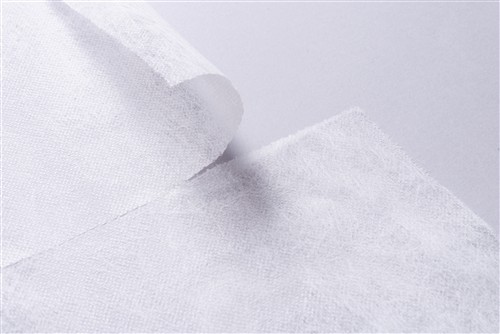
PP-based nonwoven material – typical fields of application: healthcare, packaging, construction
The problem – when speed is not matched by accuracy
In principle, the speed and flexibility of the new line offered a competitive advantage. In reality, however, the existing volumetric dosing system imposed serious limits on efficiency gains:
Colour inconsistency: volumetric dosing cannot compensate in real time for variations in material density and flow characteristics — batches produced on one shift differed from those on another.
Recipe inaccuracy: particularly when dosing fillers and additives, the ± tolerances far exceeded the design targets.
Colour change = long downtime: the line, configured for 27 colours, required manual cleaning at every changeover, leading to recurring shift-by-shift production losses.
Market pressure: several long-standing customers had started in-house production, leaving the manufacturer no further room for compromise on quality.
"The machine had the capacity, but the dosing system could not keep up with it. We were losing every day — in material, in time and in customer trust."
The solution – LIAD ColorSave 1000 gravimetric doser
We developed the solution together with LIAD's local distributor, Plast Sur. We carried out the integration step by step in cooperation with the customer's engineering team:
Mechanical adaptation: we adapted the doser mounting to the geometry of the existing production line.
Electrical integration: the ColorSave 1000 was wired into the line's centralised control panel.
Recipe programming: recipes for 27 colours and several additives were uploaded to the doser controllers.
Operator training: the line's personnel received complete training on operating the gravimetric system.
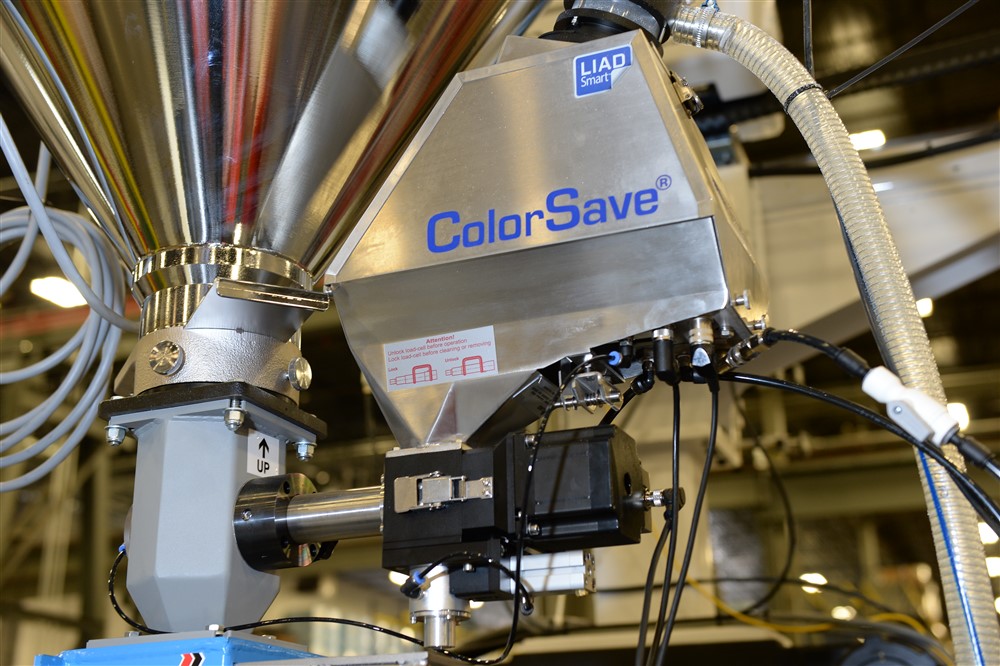
LIAD ColorSave 1000 – the single-hopper gravimetric doser that has become the industry standard
The ColorSave 1000 is the most widely used single-hopper gravimetric doser on the market. Its continuous loss-in-weight measurement principle means the doser measures the masterbatch consumed in real time and corrects automatically — to a tight ±0.1% accuracy, regardless of the machine cycle and the flow characteristics of the material.
The integrated SmartClean® technology uses compressed-air automatic purging to prepare for a colour change in minutes — at the press of a single button.
Results – numbers that convince
Switching to gravimetric dosing had immediate, far-reaching effects across every level of production:
Indicator | Volumetric (previous) | Gravimetric (ColorSave 1000) |
|---|---|---|
Colour-change downtime | Long, manual cleaning | Reduced by 70% (via SmartClean®) |
Dosing accuracy | ±3–5% | ±0.1% |
Colour consistency between shifts | Variable | Identical on every shift |
Masterbatch usage | Compensated by overdosing | Optimised, measured usage |
Verified annual saving | — | USD 446,000 |
Further savings potential | — | Over USD 1.1 million |
The 27 colours can now be handled accurately, independently of shift and operator. The manufacturer has reinforced its position in the segment that demands premium quality and now has genuine, data-driven insight into its own material consumption.
Why is this relevant to processing-industry manufacturers in our region?
The case above took place at a Latin-American manufacturer, but the underlying situation — and the solution — apply just as much in Hungary and the wider region:
If volumetric dosers handle masterbatch or filler dosing in your plant, overdosing is probably taking place — and that has a price.
If a colour change takes more than 10 minutes, SmartClean® alone can deliver the return on the investment.
If production runs across multiple shifts, gravimetric measurement is the only way to achieve operator-independent, consistent quality.
The LIAD ColorSave 1000 (and the newer 1000X generation) is available in Hungary through Cyber in Systems Kft., with installation and integration support.
Technical summary
Characteristic | Data |
|---|---|
Equipment used | LIAD ColorSave 1000 gravimetric doser |
Industry | Nonwoven (PP-based spunbond line) |
Capacity | 4,000 tonnes/year line; 12,000 tonnes/year total production |
Materials handled | Masterbatch + fillers; 27 colours |
Dosing accuracy | ±0.1% |
Verified annual saving | USD 446,000 (~EUR 360,000) |
Region of installation | Latin America (Argentina) |
Integration partner | Plast Sur (official LIAD distributor) |
Source: LIAD Smart / Ampacet — Precision in Every Fiber: How LIAD Helped Streamline Nonwoven Production. The case study illustrates a global application of the LIAD product family distributed by CIS. For questions relating to Hungary please contact the Cyber in Systems Kft. team.
Want to achieve similar results?
Request a free consultation — our experts will help you choose the best solution.
Free consultation →